

Over 70% of urban gardeners successfully grow fruit trees in containers. You can too, even with limited balcony space. Selecting the right dwarf varieties and containers makes all the difference. Proper soil drainage and strategic placement are critical for healthy growth. Wondering which specific trees will thrive in your small space?
Why Fruit Trees Thrive in Small Spaces
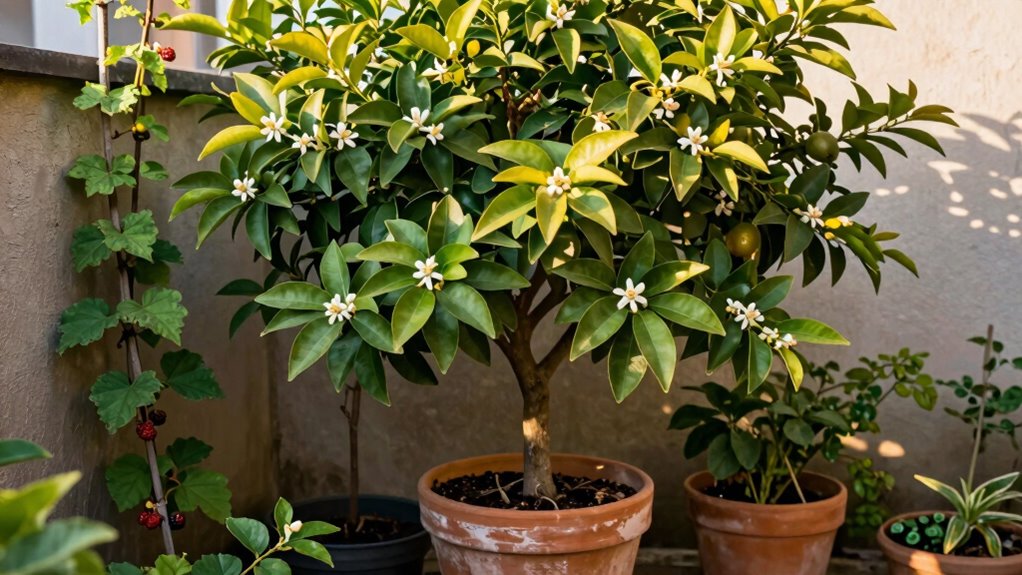
While many gardeners assume that fruit trees require expansive acreage, you can successfully cultivate productive orchards in surprisingly compact areas.
Modern dwarfing rootstocks allow full-sized fruit production within minimal space requirements. You’ll discover that container growing, strategic pruning, and vertical training techniques maximize your growing potential.
Compact varieties respond well to high-density planting methods, producing abundant yields per square foot. Your small-space orchard benefits from easier maintenance, improved pest control, and enhanced accessibility for harvesting.
Climate control becomes more manageable in contained environments. You’re not limited by traditional spacing myths – proper cultivar selection and training methods let you achieve impressive productivity.
Community gardeners especially thrive with these approaches, creating bountiful harvests despite space constraints. Small-scale cultivation eliminates the intimidation factor while delivering genuine results.
Top Dwarf Fruit Trees for Balconies and Patios
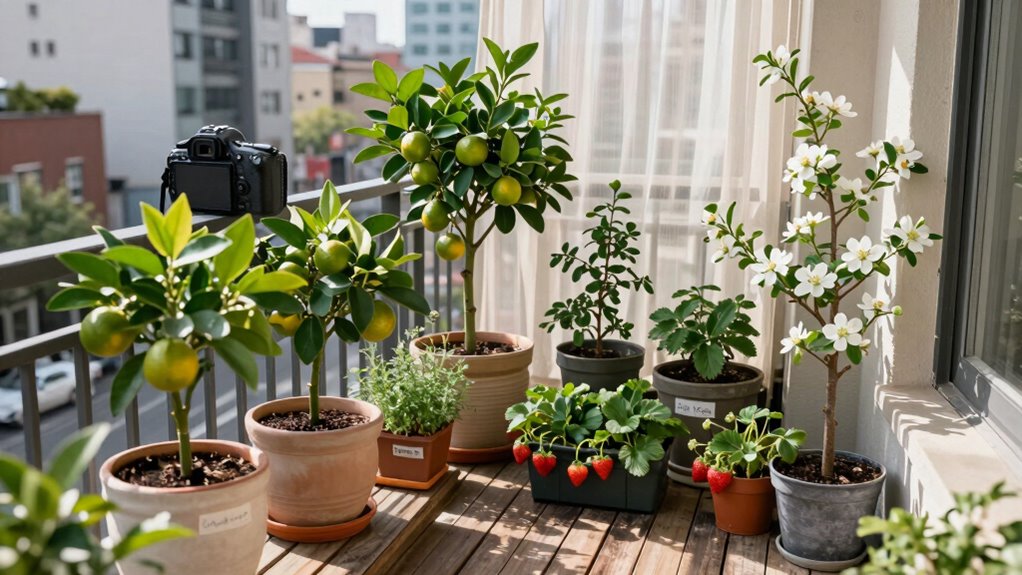
Building on the space-efficient principles of small-scale fruit cultivation, you can successfully grow dwarf fruit trees in containers on balconies and patios.
Select compact varieties like dwarf Meyer lemon, which produces fragrant fruit year-round. Choose dwarf apple trees such as ‘Gala’ or ‘Honeycrisp’ for fresh eating. Dwarf peach trees like ‘Bonanza’ offer excellent flavor in small spaces. Citrus varieties including dwarf kumquat and calamondin thrive in containers. Fig trees, particularly ‘Petite Negri’, adapt well to patio conditions. Cherry lovers should consider dwarf Bing or Rainier varieties.
These trees typically reach 4-8 feet tall, making them perfect for balconies. They require minimal pruning and produce full-sized fruit. You’ll enjoy fresh harvests while maximizing limited space.
These dwarf selections prove that small areas can yield abundant, delicious fruit crops.
Choosing the Best Containers for Fruit Trees
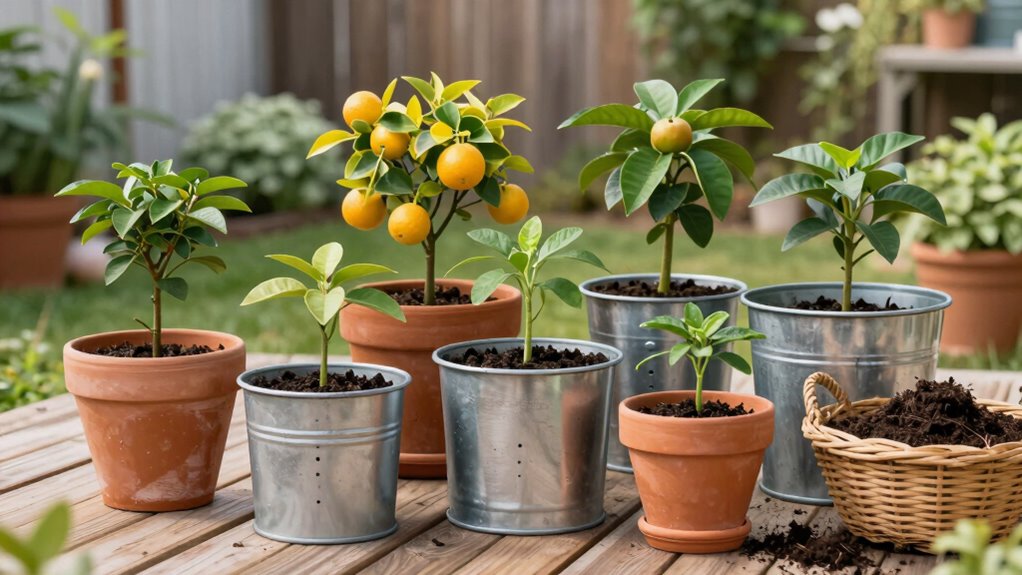
Selecting appropriate containers guarantees healthy growth and ideal fruit production for your dwarf trees. You should choose containers that are at least 15-20 gallons for most dwarf varieties, providing adequate root space.
Opt for durable materials like glazed ceramic, fiberglass, or heavy-duty plastic that won’t crack over time. Clay pots provide excellent breathability but dry out quickly. Ascertain your containers have multiple drainage holes to prevent waterlogging. Consider self-watering containers for consistent moisture levels.
Lightweight options like fabric pots promote air-pruning of roots. Measure your tree’s mature width and select containers accordingly. Dark-colored pots absorb more heat, so light colors work better in hot climates. You’ll want stability, so choose containers with wide bases.
Regularly inspect for cracks or damage that could compromise root health.
Soil and Drainage Tips for Potted Trees
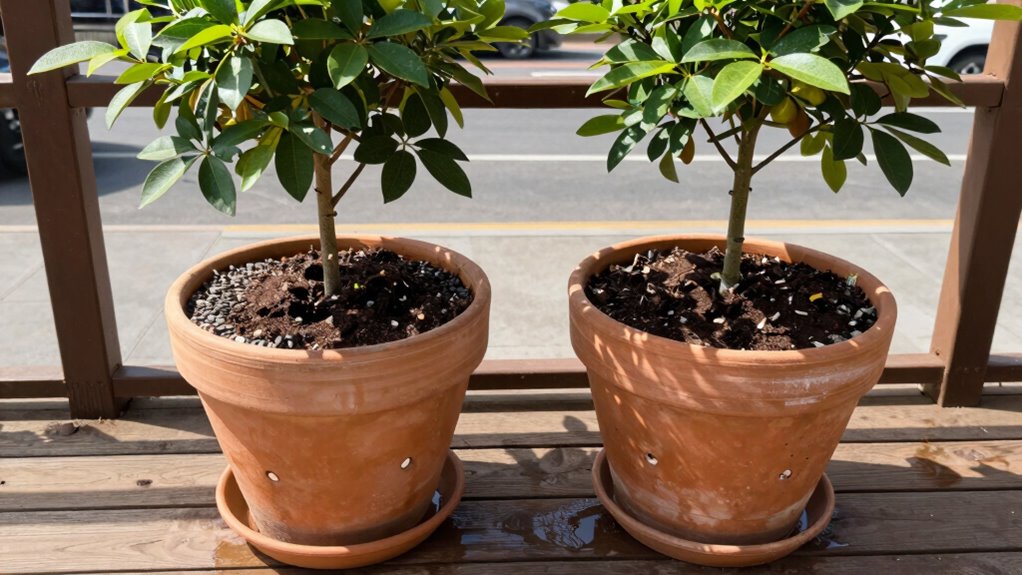
Proper soil composition and drainage are essential factors that directly impact your potted fruit trees’ health and productivity. You need well-draining soil mixtures containing perlite, vermiculite, or coarse sand for ideal root development. Heavy soils cause waterlogging, leading to root rot and nutrient deficiencies.
- Use high-quality potting mix specifically designed for container growing
- Add perlite or vermiculite to improve aeration and drainage
- Incorporate coarse sand for better water flow through soil particles
- Guarantee containers have adequate drainage holes to prevent water accumulation
- Test soil pH regularly and adjust between 6.0-7.0 for most fruit trees
Your trees depend on proper soil structure for nutrient uptake and oxygen circulation around roots.
Monitor moisture levels carefully and avoid compacted soil conditions. These practices create thriving potted fruit trees.
Where to Place Trees for Maximum Sunlight
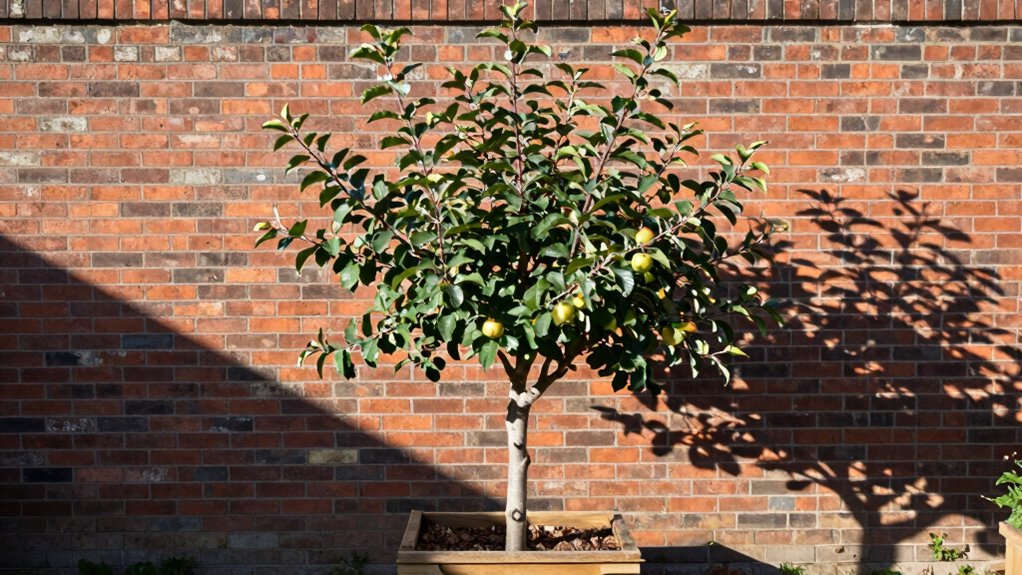
Most fruit trees need full sun exposure to produce healthy foliage and abundant fruit yields. You should position your trees where they receive at least six hours of direct sunlight daily.
South-facing locations typically provide ideal light conditions. Avoid placing trees near buildings, fences, or larger plants that cast shadows during peak sun hours.
Monitor light patterns throughout different seasons, as sun angles change considerably. Container-grown trees offer flexibility to move them to sunnier spots as needed.
Consider reflective surfaces like white walls or light-colored mulch to enhance light exposure. Watch for signs of insufficient light, including sparse foliage, weak growth, and poor fruit development.
Don’t overlook microclimates created by slopes or depressions that might affect sun exposure duration and intensity throughout your growing space.
Can You Grow Citrus and Tropical Fruits Indoors?
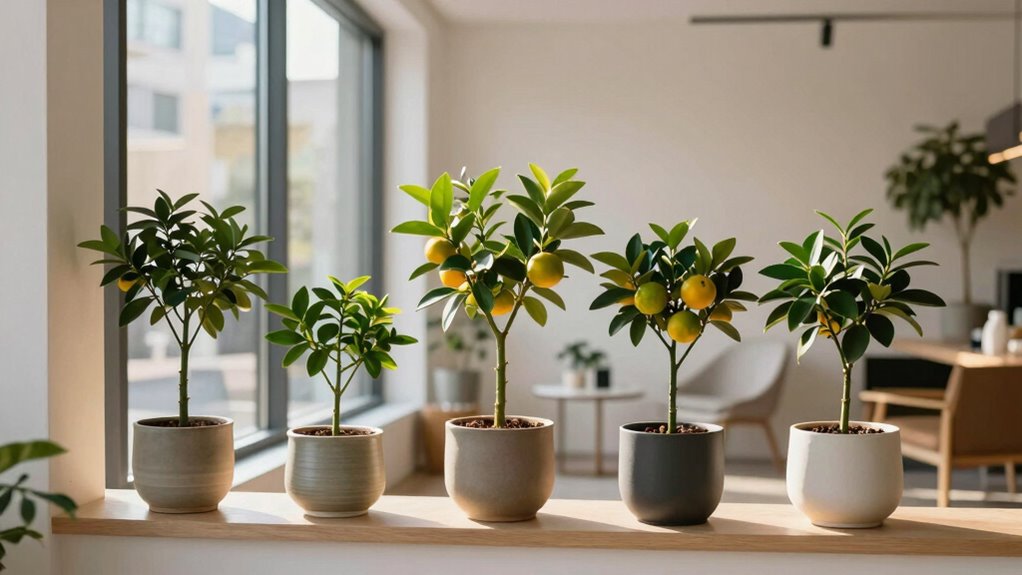
Why shouldn’t you attempt growing citrus and tropical fruits indoors when you’re limited by space or climate constraints?
You can successfully cultivate these fruits inside with proper techniques and conditions.
Growing citrus and tropical fruits indoors requires specific environmental controls and careful attention to plant needs. You’ll need to master temperature regulation, humidity control, and adequate lighting systems.
- Choose dwarf varieties like Meyer lemon, calamondin, or kumquat for manageable sizes
- Provide 6-8 hours of direct sunlight or full-spectrum LED grow lights
- Maintain temperatures between 65-85°F with consistent humidity levels
- Use well-draining potting mix with pH levels between 6.0-7.0
- Hand-pollinate flowers regularly since indoor conditions lack natural pollinators
You belong among successful indoor fruit growers when you understand these fundamental requirements.
Save Space With Espalier-Trained Fruit Trees
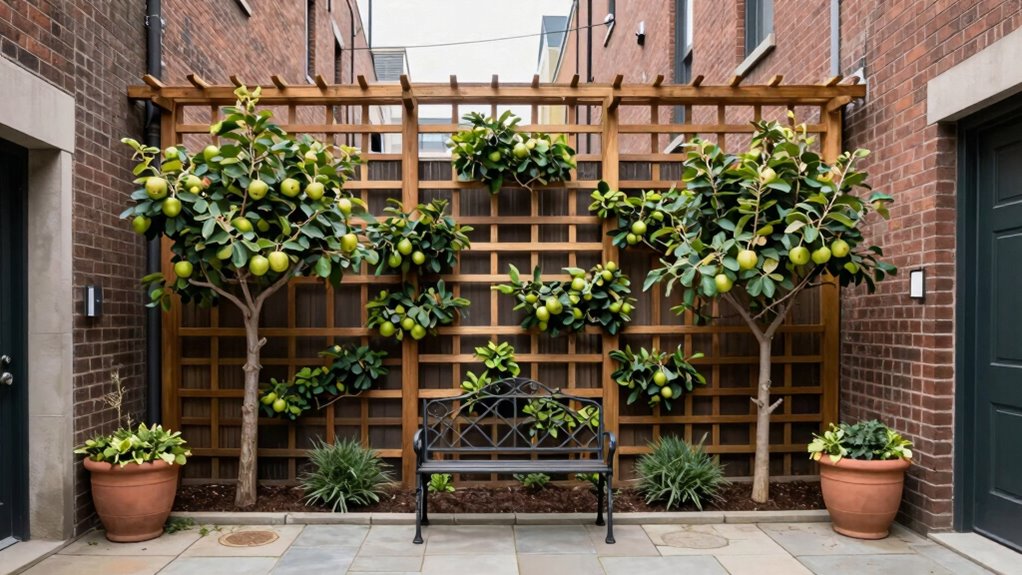
You’ll maximize your growing space by selecting dwarf or semi-dwarf fruit tree varieties that respond well to training.
Install sturdy horizontal wires or wooden slats as your support framework before planting your trees.
Prune your trees regularly to maintain flat, two-dimensional growth patterns against your chosen support structure.
Choose Right Tree Varieties
How much space do you really need to grow productive fruit trees? You can maximize your small space by selecting the right espalier-trained varieties. These trees aren’t just space-savers; they’re designed for ideal fruit production in limited areas.
When choosing varieties, you’ll want to take into account:
- Dwarf and semi-dwarf rootstocks that naturally stay compact while producing full-size fruit
- Columnar apple varieties like Northpole or Scarlet Sentinel that grow vertically
- Citrus trees such as Meyer lemon or kumquat that adapt well to training
- Stone fruits including dwarf peach or nectarine varieties perfect for espalier
- European pear cultivars like Seckel or Anjou that respond well to horizontal training
Select varieties based on your climate zone and desired harvest time. Research each tree’s mature size and growth habits.
You’re not just buying trees; you’re investing in your future harvests. Make choices that align with your space constraints and fruit preferences.
Install Proper Support Structures
Espalier-trained fruit trees require sturdy support structures to maintain their flat, two-dimensional growth pattern and maximize fruit production in minimal space.
You’ll need to install heavy-duty trellises, wires, or wooden frames before planting. Anchor these supports securely into solid ground or masonry walls. Use galvanized wire stretched between posts or attach wooden slats directly to walls. Space horizontal wires eighteen inches apart, starting sixteen inches from ground level.
Vertical supports work best for simple cordons. Metal brackets bolted to walls provide excellent anchor points for individual branches. Verify all materials are weather-resistant and strong enough to handle mature tree weight plus fruit load.
Proper installation prevents structural failure and maintains your tree’s productive shape.
Prune For Flat Growth Patterns
While espalier-trained fruit trees require careful structural support, their flat growth patterns demand equally precise pruning techniques to maximize fruit production in minimal space. You’ll need to develop sharp pruning skills that encourage horizontal branching while maintaining vertical stems.
- Cut back vertical shoots aggressively to redirect energy into horizontal branches.
- Prune lateral branches to outward-facing buds to promote flat growth against supports.
- Remove competing branches that grow away from the desired plane.
- Trim branch tips regularly to maintain the established pattern and prevent overcrowding.
- Make clean cuts at bud angles to avoid stubs that invite disease.
Your pruning cuts should always support the tree’s two-dimensional shape. Don’t remove more than 25% of growth annually.
Focus on maintaining the espalier form while preserving fruiting wood. Regular maintenance prevents structural issues and keeps your trees productive within their confined space.
Watering and Fertilizing Potted Fruit Trees
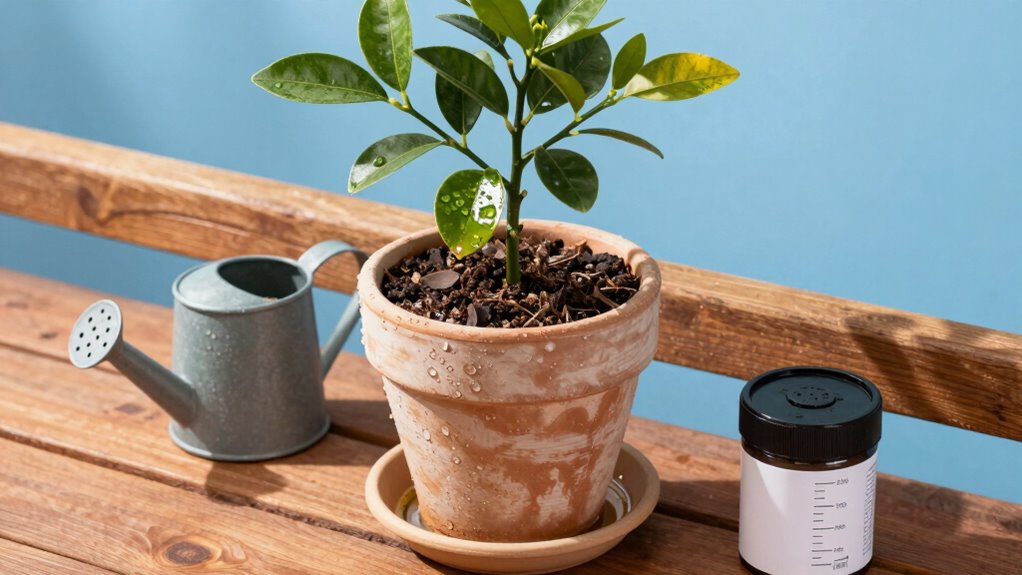
Since potted fruit trees have limited root space, you must carefully monitor their watering and fertilizing needs to prevent nutrient deficiencies and water stress.
Check soil moisture daily by inserting your finger two inches deep; water when dry. Use slow-release fertilizers in spring, supplementing with liquid feed every two weeks during growing season.
Avoid over-fertilizing, which causes salt buildup and root burn. Choose balanced NPK formulas (10-10-10) for general health, switching to lower nitrogen ratios during fruiting.
Apply fertilizer to moist soil, never dry conditions. Mulch containers lightly to retain moisture, but don’t over-mulch.
Flush pots monthly with excess water to prevent mineral accumulation. Adjust frequency based on tree species, pot size, and climate conditions.
Pests That Target Container Fruit Trees
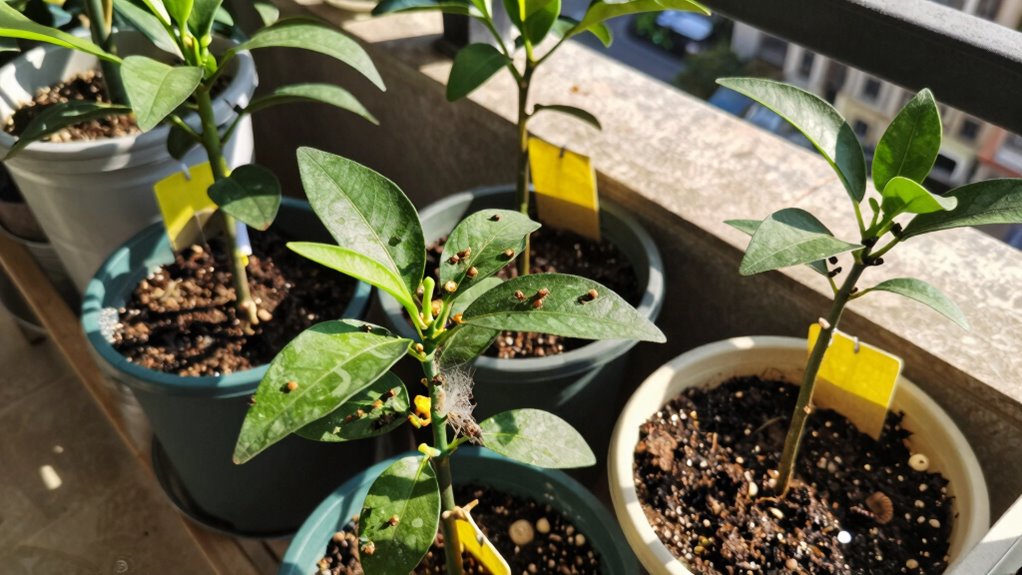
Container fruit trees face numerous pest threats that can quickly devastate your crop if left unchecked. You must monitor your plants regularly since container environments concentrate pest pressure.
Common invaders target leaves, fruit, and root systems, often spreading between closely spaced potted trees.
- Aphids cluster on new growth and undersides of leaves, sucking sap and transmitting viruses.
- Spider mites create fine webbing while feeding, causing stippled yellowing foliage.
- Scale insects attach to bark and stems, appearing as brown or white bumps that drain plant juices.
- Fungus gnats breed in moist soil, with larvae feeding on root hairs and organic matter.
- Thrips scrape fruit and leaf surfaces, leaving silvery trails and black fecal spots.
You should implement integrated pest management strategies immediately when identifying these threats.
Pruning Fruit Trees in Small Spaces
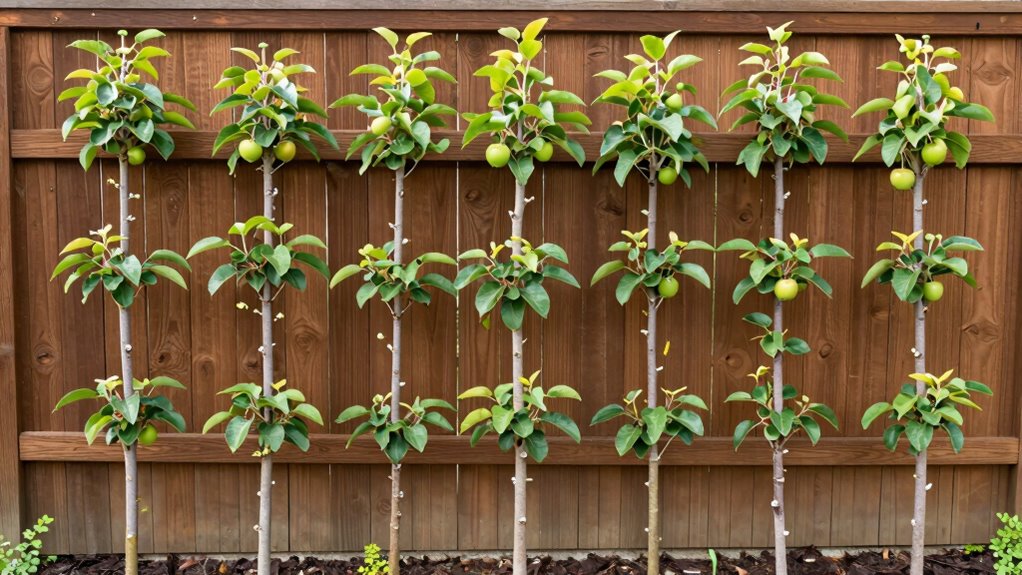
Proper pruning techniques become even more critical when managing fruit trees in confined areas where space limitations amplify the impact of each cut. You must maintain strict control over tree size while maximizing fruit production.
Focus on removing dead, diseased, or crossing branches first. Cut back vigorous vertical shoots that consume energy without producing fruit. You should aim for an open-center or espalier shape that allows light penetration and air circulation.
Make clean cuts at forty-five-degree angles just above buds or branch collars. Don’t remove more than twenty-five percent of growth annually. You’ll achieve better results by pruning during dormant seasons.
Regular maintenance prevents overcrowding and guarantees healthy fruit development. Your careful attention to pruning details determines whether your compact trees thrive or struggle in limited spaces.
Harvesting Tips for Compact Fruit Gardens
When you’re managing compact fruit gardens, timing your harvest correctly guarantees peak flavor and texture while preventing waste. You’ll maximize your limited space by understanding each variety’s ideal picking window.
- Check fruit firmness daily during ripening season; slight softening indicates readiness.
- Harvest morning fruits when dew has dried but temperatures remain cool.
- Pick fruits with gentle upward twist rather than pulling downward.
- Remove any damaged or diseased fruits immediately to prevent spread.
- Store different varieties separately since ethylene production varies greatly.
You’ll develop intuition through observation, watching color changes, sugar development, and natural dropping patterns.
Keep detailed records of harvest dates yearly to refine your timing accuracy.
Conclusion
You’ve learned that growing fruit trees in small spaces is entirely possible with the right approach. By selecting dwarf varieties, using proper containers, and following essential care techniques, you’ll enjoy fresh fruits even in limited areas. Remember, “the best things come in small packages” – your compact orchard can be just as productive as larger ones when you apply these principles correctly.
