

You’re standing in the tool aisle, staring at two nearly identical drills, yet one promises freedom while the other guarantees grunt. Choosing between corded and cordless tools isn’t just about convenience—it’s about understanding how power delivery, battery limitations, and job site demands directly impact your productivity. Let’s break down what really matters when selecting the right tool for the job.
What Makes Corded and Cordless Tools Different?
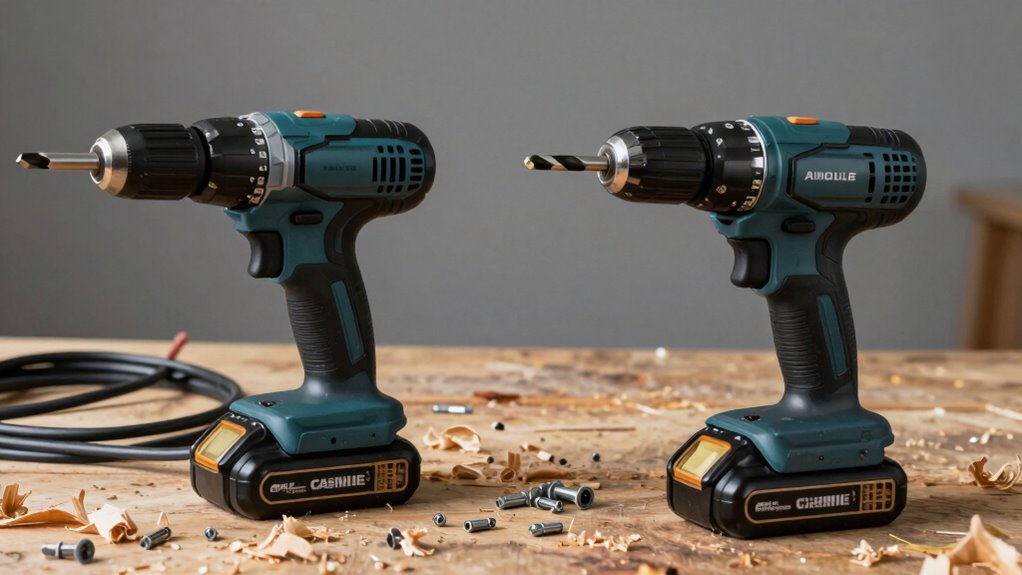
Corded and cordless tools differ fundamentally in their power source and operational constraints.
You’ll notice corded tools draw continuous electricity from wall outlets, eliminating battery limitations while delivering consistent power output.
Cordless tools rely on rechargeable batteries, offering mobility but requiring periodic charging and eventual replacement. You’re trading unrestricted movement for power consistency.
Corded tools typically weigh more due to motors and cord management systems. You’ll experience less fatigue during extended use compared to lifting heavier cordless alternatives.
Cordless tools provide portability advantages, letting you work in remote locations without electrical access. You’ll appreciate this flexibility when working outdoors or in unfinished spaces.
Battery technology advances continue improving cordless performance, but you’ll still face runtime limitations. You’re making a trade-off between convenience and continuous operation.
Do You Need Maximum Power? Choose Based on Job Type
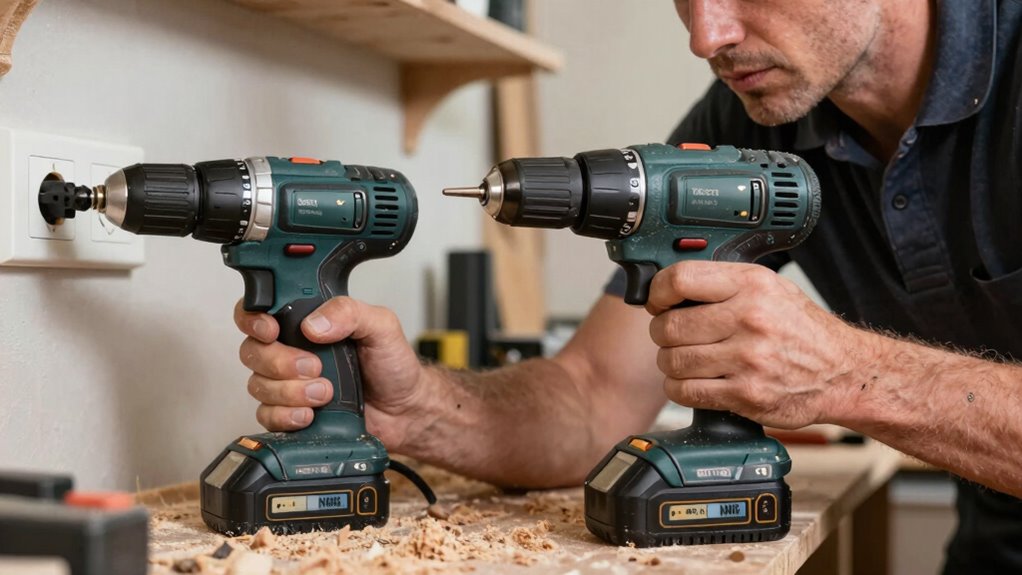
You must evaluate your power needs based on specific job requirements rather than assuming all tasks demand maximum output.
Heavy-duty applications like concrete cutting or metal fabrication require corded tools that deliver consistent high torque without battery limitations.
Lighter tasks such as trimming or drilling small holes perform adequately with cordless tools that offer sufficient power while providing mobility and convenience.
Maximum Power Requirements
Power demands vary greatly based on your specific application, and understanding these requirements helps determine whether corded or cordless tools meet your needs.
You need maximum power for heavy-duty applications like breaking concrete, cutting thick metal, or drilling through masonry. Corded tools typically deliver consistent high torque and amperage without battery limitations. Your workshop tasks requiring sustained power output favor plug-in models.
Woodworking projects demanding precise cuts at specific speeds benefit from corded stability. Don’t overlook voltage ratings when comparing options. Higher voltage cordless tools approach corded performance but cost considerably more.
You should match tool power to actual job demands rather than assuming maximum power is always necessary. Light-duty tasks perform adequately with lower-powered tools. Consider your typical workload intensity and duration when evaluating power requirements.
Professional contractors requiring all-day heavy use need different power considerations than weekend DIY enthusiasts tackling occasional projects.
Job-Specific Tool Selection
Having established how power demands differ across applications, matching tool type to specific job requirements becomes the next critical step.
You need to evaluate your work environment systematically. Construction sites demand heavy-duty corded drills for continuous operation and maximum torque. Woodworking shops benefit from cordless freedom when moving between workstations.
Automotive repair requires compact cordless impact wrenches for tight spaces. Landscaping contractors rely on corded hedge trimmers for extended runtime.
You should consider dust exposure, requiring cordless tools with sealed motors. Wet conditions demand cordless safety. Your workshop layout determines reach requirements.
Professional users often maintain both types, selecting based on task duration and power needs. Don’t overlook battery life calculations for multi-hour jobs.
Your specific trade determines ideal voltage requirements and tool specifications.
When Portability Outweighs Power: Cordless Tools Win
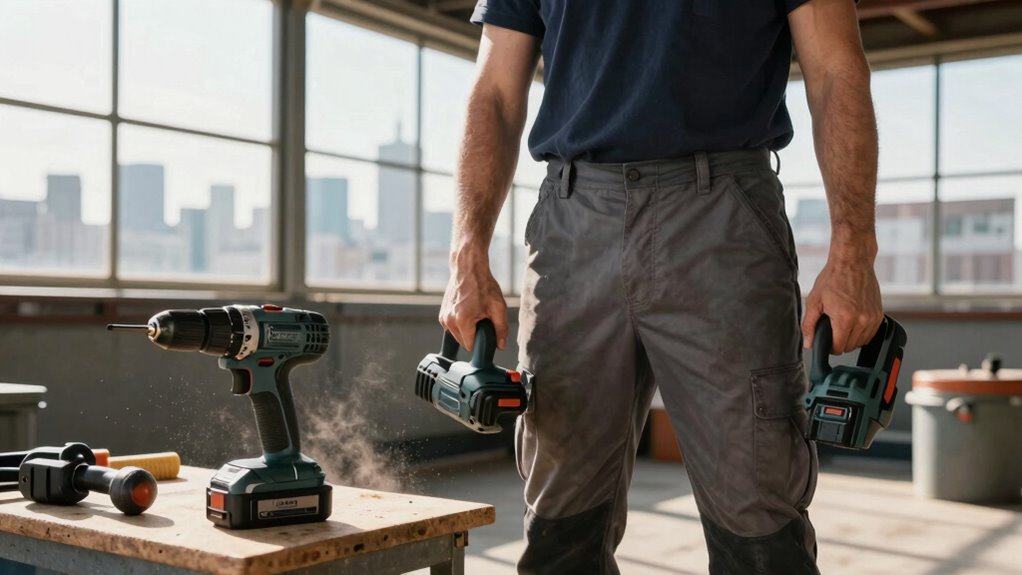
You should choose cordless tools when you need to work in multiple locations without access to power outlets, because their portability advantages become critical for job site efficiency.
Your battery life decisions must balance runtime requirements against tool weight and charging infrastructure availability.
These tools win when mobility constraints outweigh power demands, making them essential for remote installations and extended field work.
Portability Over Power
While cordless tools may sacrifice some raw power compared to their corded counterparts, their portability often proves more valuable in real-world applications where mobility and convenience matter most.
You’ll find yourself working in tight spaces, climbing ladders, or moving between job sites where dragging extension cords becomes impractical. Cordless tools eliminate these constraints, letting you work freely without power outlet limitations.
Their compact design reduces fatigue during extended use, while their lightweight construction makes transportation effortless. You’re not tethered to electrical sources, which means you can work in remote locations, unfinished basements, or outdoor areas without accessible power.
This freedom enhances your productivity and workflow efficiency. When you prioritize maneuverability over maximum torque or cutting capacity, cordless tools deliver the flexibility you need.
They’re designed for professionals who value independence and adaptability on the job.
Battery Life Considerations
Although cordless tools offer unmatched portability, their effectiveness depends heavily on battery performance and runtime. You need to evaluate amp-hour ratings and voltage specifications to determine actual working time.
Higher voltage doesn’t always mean longer runtime; lithium-ion batteries typically outperform older nickel-based technologies. Consider your workflow patterns – intermittent use favors cordless options, while continuous operation may drain batteries quickly.
Temperature affects performance too; cold conditions reduce capacity considerably. You should also factor in charging time and whether you need spare batteries for extended projects.
Battery age degrades performance, so replace units showing reduced runtime. Smart battery indicators help you monitor remaining power, preventing unexpected shutdowns mid-task.
Match battery capacity to your specific application demands.
How Battery Life Shapes Your Workday Productivity
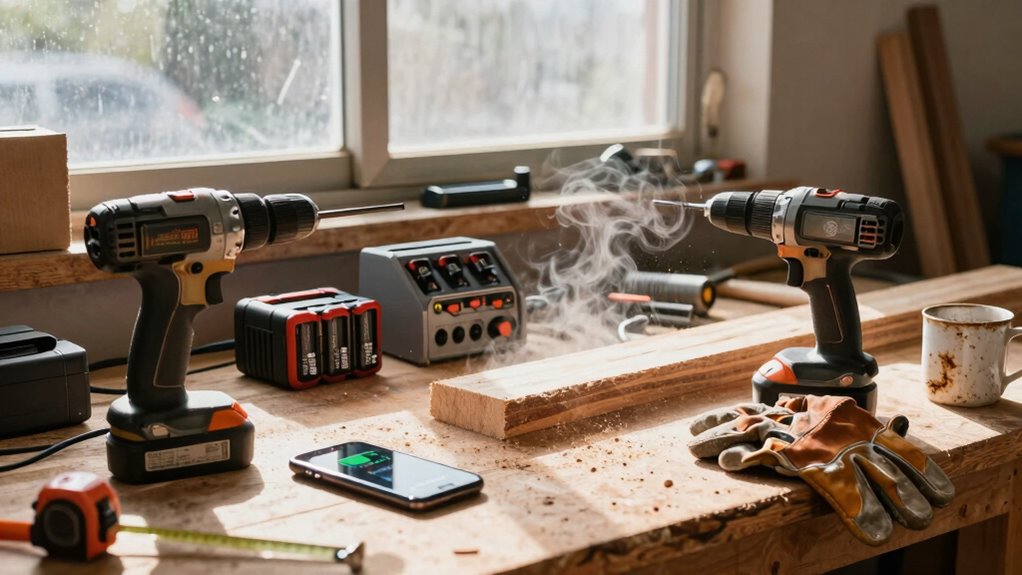
When battery life falls short during extended work sessions, your productivity suffers from unplanned interruptions and time lost to recharging cycles.
You’ll find yourself constantly monitoring power levels, scheduling breaks around charging stations, and carrying backup batteries that add bulk to your toolkit.
Low battery warnings force you to abandon tasks mid-completion, breaking your workflow momentum.
Extended projects demand strategic planning around power availability, limiting your mobility and flexibility.
You’ll experience frustration when tools suddenly die during critical moments, causing delays that ripple through your entire schedule.
Poor battery management creates dependency on electrical outlets, restricting where you can work effectively.
Your daily output decreases markedly when you can’t maintain consistent power supply, ultimately affecting job completion rates and professional reliability.
Should You Rely on Consistent Performance? Check Corded Tools
Because corded tools eliminate the variables associated with battery degradation and power management, you can maintain consistent performance throughout extended work sessions without interruption.
You’ll never experience sudden power drops or gradual slowdowns that compromise your work quality. Professional-grade corded tools deliver sustained torque and power output, ensuring your drill maintains consistent RPM regardless of workload duration.
You don’t need to monitor battery levels or plan charging cycles around your workflow. Temperature fluctuations won’t affect performance since there’s no battery pack generating heat.
You’ll achieve precise results repeatedly because corded tools eliminate performance variability. When you’re working on critical projects where consistency matters, corded tools become your reliable foundation.
You belong in the professional category when you choose tools that eliminate guesswork and deliver unwavering performance.
Will You Be Working Off-Grid? Go Cordless
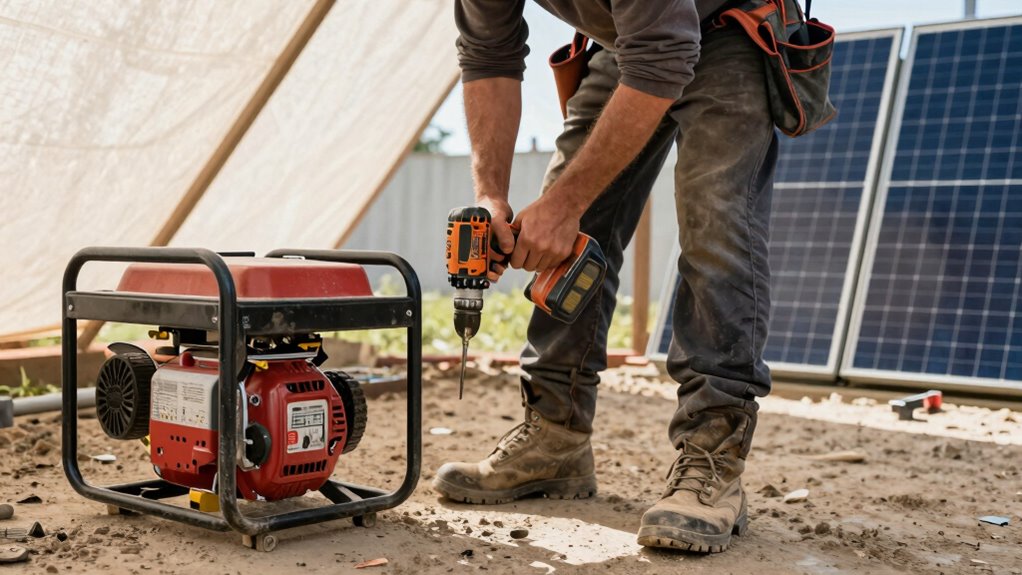
Freedom from power outlets defines the primary advantage of cordless tools.
You’ll appreciate this mobility when working in remote locations, construction sites, or areas without electrical infrastructure. Cordless tools eliminate the need for extension cords, generators, or power source planning.
You can move freely between work zones without worrying about cord length limitations or outlet availability. Battery-powered tools are essential for off-grid projects, emergency repairs, and outdoor work where electricity isn’t accessible. Modern lithium-ion batteries provide reliable power for extended periods, making cordless tools practical for demanding tasks.
You’ll find cordless options suitable for drilling, cutting, grinding, and fastening applications. Professional tradespeople and DIY enthusiasts benefit from this portability when traditional power sources aren’t available.
Cost vs Convenience: Choosing Tools That Fit Your Budget
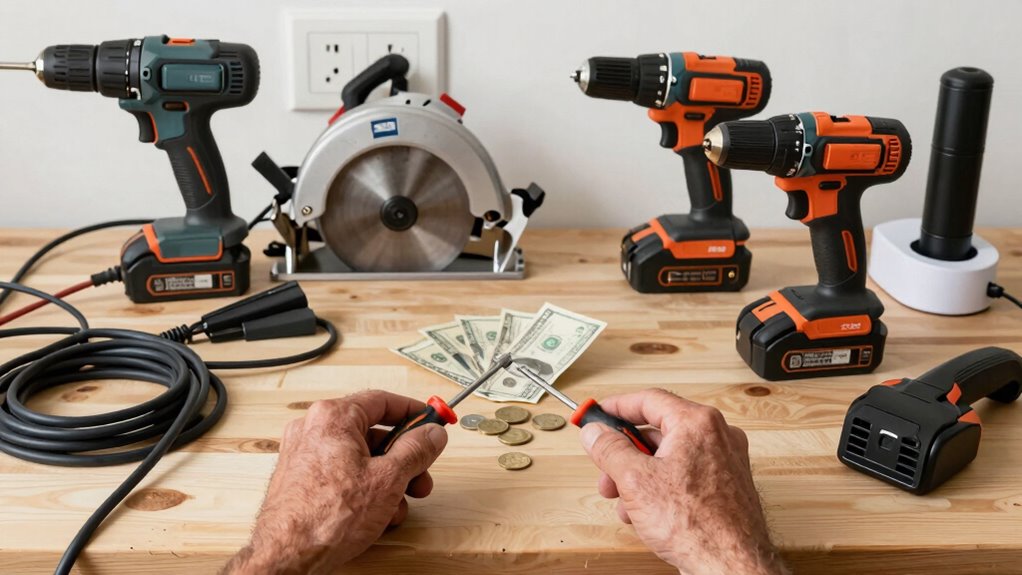
While cordless tools offer unmatched portability, their upfront costs often exceed those of corded alternatives, making budget considerations crucial for your purchasing decision.
You’ll need to balance initial investment against long-term value and convenience.
- Battery replacement costs – Cordless tools require battery replacements every 2-3 years, adding $100-300 to ownership costs.
- Power-to-price ratio – Corded tools deliver consistent power at lower price points, especially for heavy-duty applications.
- Multi-tool compatibility – Invest in cordless systems where one battery powers multiple tools, maximizing your investment.
- Usage frequency impact – Frequent users justify higher cordless costs through increased productivity and convenience.
Your budget determines whether convenience trumps initial savings.
Why Some Projects Only Work With Corded Tools
Certain demanding applications require the sustained power delivery that only corded tools can provide, making them indispensable for specific project types.
You’ll find yourself reaching for corded tools when tackling extended concrete drilling, heavy-duty demolition, or continuous framing work where power depletion isn’t an option. Your cordless tools simply can’t match the consistent torque and runtime that hardwired models deliver.
Professional-grade corded drills maintain their performance throughout entire workdays, while cordless batteries degrade during prolonged use. You belong in situations demanding reliability – think construction sites, workshops, or industrial settings where workflow interruptions cost money.
Don’t compromise on power when your project demands maximum output. Your work quality depends on tools that won’t quit mid-task.
Conclusion
So you’re standing there, drill in hand, wondering which path to take. Corded tools promise unwavering power for heavy-duty battles, while cordless offers freedom from electrical tyranny. Your budget whispers constraints, but productivity demands reliability. Will you choose the tethered workhorse or the mobile warrior? The decision hinges on your project’s true nature – maximum power or ultimate portability. Choose wisely, because your workflow’s efficiency hangs in the balance.
