

You might think any bright light will do for garage work, but inadequate illumination causes accidents and eye strain. Proper work lighting requires matching lumens to tasks—400-800 lumens minimum for general use. LED technology offers superior longevity and efficiency compared to traditional bulbs. Beyond brightness, you’ll need to take into account mounting options, power sources, and safety certifications. Without the right setup, even the brightest light won’t prevent workplace injuries or deliver consistent performance during extended projects.
Match Garage Tasks to the Right Light
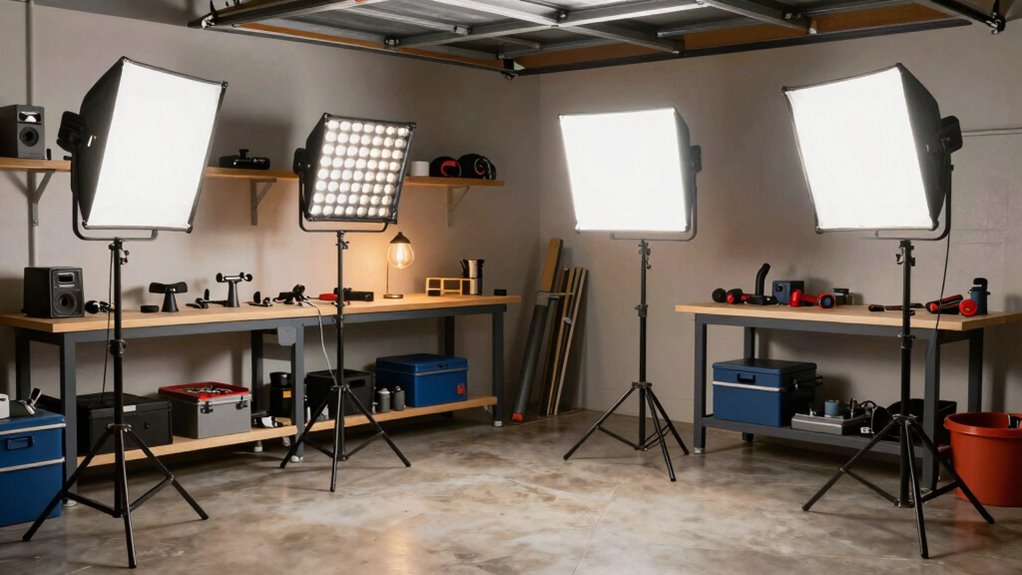
When you’re working on automotive repairs, detailed craft projects, or general maintenance tasks in your garage, selecting the appropriate work light becomes critical for both productivity and safety.
You’ll want LED work lights for automotive tasks, offering superior illumination without overheating. Magnetic base lights work best for metal surfaces, ensuring stability during engine work. For detailed projects requiring precision, choose adjustable arm lights that let you direct beams exactly where needed.
Battery-powered options give you mobility when electrical outlets aren’t accessible. Consider clip-on models for hands-free operation during prolonged tasks. Always look for lights with protective cages to prevent bulb damage.
You should match light specifications to your specific garage activities. Heavy-duty construction requires robust, high-lumen options, while electronics work demands softer, focused lighting to avoid glare and shadows that compromise visibility.
Understand Brightness Levels That Fit Your Space
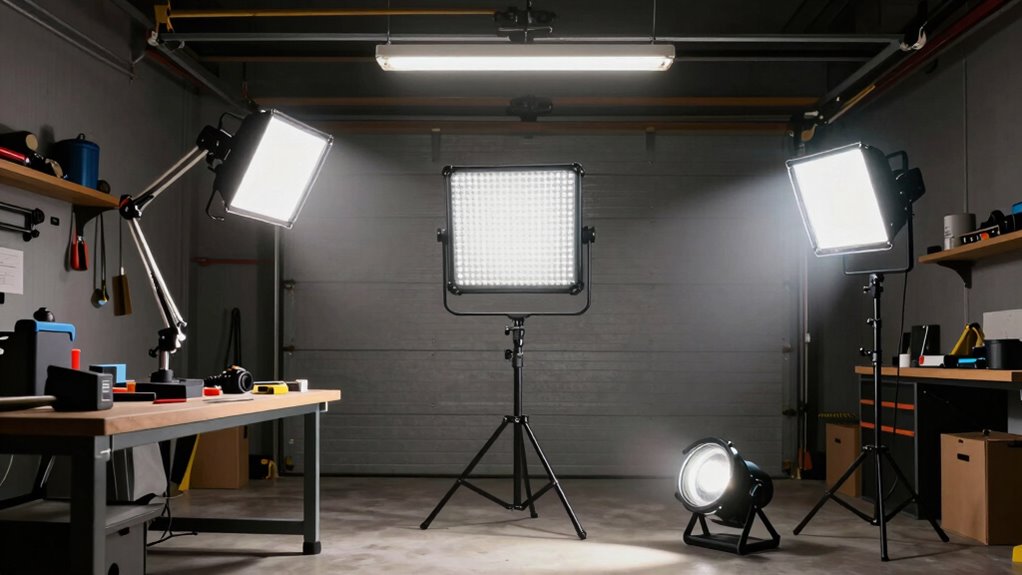
You must evaluate lumens carefully since inadequate brightness creates safety hazards during automotive repairs or woodworking tasks.
Different bulb types produce varying lumen outputs, so match LED, fluorescent, or incandescent options to your specific workspace requirements.
Proper brightness assessment prevents eye strain and guarantees you can clearly see hazards, tools, and work details.
Assess Lumens For Visibility
Since different garage activities demand varying levels of illumination, understanding lumen output becomes crucial for maintaining both productivity and safety in your workspace.
You need adequate brightness to prevent accidents and guarantee precision during tasks.
- Basic visibility requires 100-200 lumens for simple storage areas
- General work zones need 400-800 lumens for everyday maintenance tasks
- Detailed mechanical work demands 1,000-1,500 lumens for intricate repairs
- Large garage spaces require multiple light sources distributing 2,000+ lumens total
- Safety-critical areas like electrical panels need focused 300+ lumens spot lighting
You should measure your garage’s square footage and identify primary activity zones.
Higher lumen outputs reduce eye strain and improve accuracy.
Don’t overlook shadows created by bulky equipment.
Proper lumen assessment prevents inadequate lighting that compromises both safety and work quality in your garage environment.
Match Bulb Types To Needs
Different bulb technologies deliver varying brightness levels and energy efficiency, making it vital to match the right type to your garage’s specific lighting demands.
LED bulbs provide superior lumens per watt, generating less heat while lasting longer than incandescent options. You should consider color temperature too—daylight LEDs (5000K-6500K) enhance visibility for detailed work.
Fluorescent bulbs offer good brightness but contain mercury, requiring careful disposal. Halogen lamps produce intense light but generate excessive heat, posing fire risks.
Choose bulbs with appropriate lumen outputs: 800-1600 lumens for general garage work, 2000+ lumens for detailed mechanical tasks.
Confirm fixtures can handle your selected bulb’s heat output. Match bulb beam angle to your workspace—narrow beams focus light where needed, while wide beams illuminate larger areas.
LED vs. Fluorescent: Which Bulb Wins?
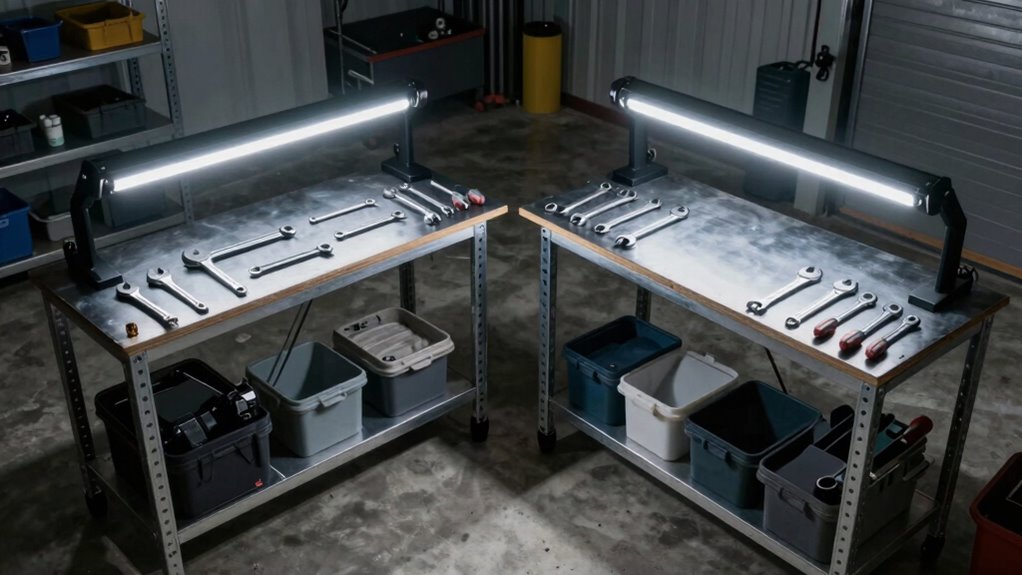
You’ll want to compare how LED and fluorescent bulbs handle energy consumption, light output, and longevity when selecting your garage work lighting.
LEDs typically consume 75% less energy than fluorescents while providing superior lumen maintenance over extended operating periods.
Your choice directly impacts both electrical safety considerations and the reliability of illumination during critical workshop tasks.
Energy Efficiency Comparison
When you’re selecting between LED and fluorescent bulbs for your garage work light, understanding their energy efficiency differences can greatly impact both your electricity costs and environmental footprint.
You’ll want to evaluate these key factors:
- Power consumption: LED bulbs use 75-80% less energy than fluorescent tubes
- Heat output: LEDs produce minimal heat, reducing cooling costs and fire risks
- Lifespan: LED bulbs last 25,000-50,000 hours compared to fluorescent’s 10,000 hours
- Startup energy: Fluorescents require high initial power surge, while LEDs start instantly
- Environmental impact: LEDs contain no mercury and are fully recyclable
You’re making a smart choice by comparing these metrics.
Your garage deserves efficient, safe lighting that won’t strain your wallet or the environment.
LEDs clearly win on energy efficiency.
Brightness And Light Quality
Brightness and light quality matter most when performing detailed tasks in your garage workspace. You need lights that reduce eye strain and prevent accidents. LED bulbs deliver superior brightness with focused beam patterns, while fluorescent options often create harsh shadows.
You should prioritize color temperature between 4000K-6500K for ideal visibility. LEDs offer instant full brightness without warm-up time, unlike fluorescents. You’ll notice better color rendering with LEDs, making it easier to distinguish wire colors or read small print.
For safety, avoid flickering fluorescent lights that cause headaches and fatigue. You want consistent illumination across your entire workspace. LED work lights provide directional lighting where you need it most, eliminating dark spots that hide potential hazards.
Choose lights with adjustable brightness settings to match specific tasks and reduce glare.
Durability And Lifespan
While both LED and fluorescent bulbs claim durability, LED technology outperforms fluorescent alternatives in harsh garage environments where temperature fluctuations and vibrations threaten bulb integrity.
You need reliable lighting that won’t fail during critical projects.
Consider these key durability factors:
- Temperature resistance: LEDs operate effectively in freezing garages and hot summer conditions
- Vibration tolerance: LED filaments won’t break like fragile fluorescent glass tubes
- Startup reliability: LEDs illuminate instantly regardless of temperature
- Shock protection: Solid-state LED construction survives accidental drops
- Long-term performance: LEDs maintain 70% brightness after 25,000 hours versus fluorescent 10,000 hours
You deserve lighting that lasts years without frequent replacements.
LED bulbs eliminate hazardous mercury exposure while providing superior longevity.
Your garage work deserves professional-grade illumination that won’t disappoint when you need it most.
Power Source Showdown: Corded vs. Cordless
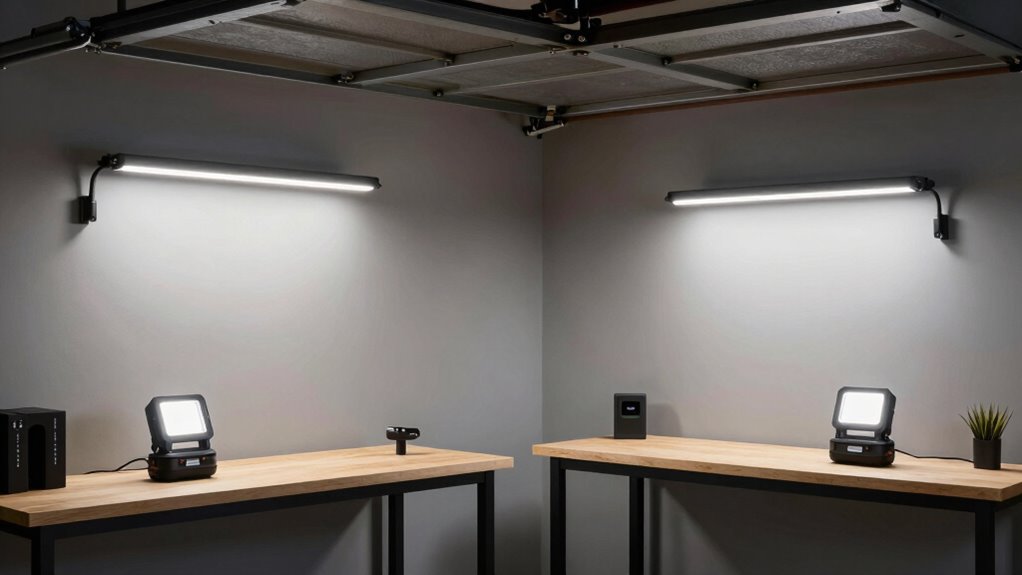
Although both corded and cordless work lights offer distinct advantages for garage applications, understanding their fundamental differences in power delivery and operational characteristics helps you make an informed decision.
Corded lights provide consistent, uninterrupted power flow, ensuring maximum brightness without battery limitations. You’ll never worry about charging cycles or runtime constraints. However, corded units restrict your mobility and create trip hazards from extension cords.
Cordless lights offer superior portability and flexible positioning, letting you illuminate any garage area effortlessly. Battery-powered units eliminate electrical hazards but require regular charging and eventual battery replacement. LED cordless models typically run eight to twelve hours on a single charge.
Consider your garage’s electrical accessibility and workspace layout. If you frequently move between areas, cordless wins. For stationary bench work, corded units deliver unwavering performance.
Evaluate your specific garage workflow patterns before deciding.
Pick the Perfect Mounting Style for Your Garage
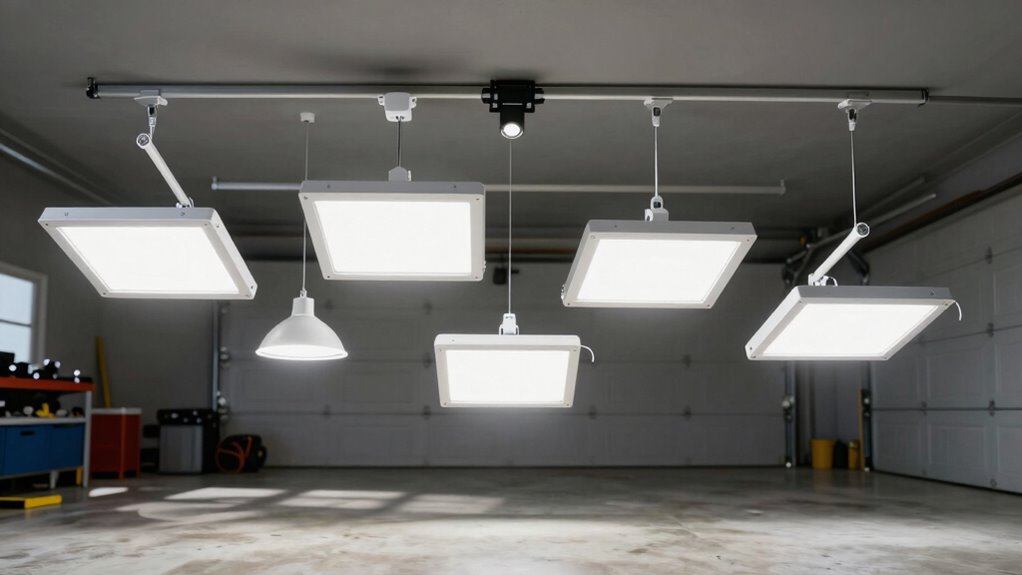
You’ll need to evaluate ceiling mount options that provide ideal light coverage for your workspace while ensuring secure installation to prevent accidental detachment during vehicle maintenance.
Wall mount solutions offer flexible positioning and easier access for bulb replacement, but require careful consideration of mounting height and angle to avoid creating shadows in critical work areas.
Both mounting styles must support the weight of your chosen work light and withstand vibrations from power tools without compromising electrical connections or structural integrity.
Ceiling Mount Options
Ceiling-mounted work lights offer the most efficient way to illuminate your entire garage workspace.
You’ll want to evaluate these key mounting options for ideal coverage:
- Surface-mounted fixtures attach directly to ceiling joists or drywall using screws, ideal for standard garage construction.
- Hanging pendant lights suspend from ceiling hooks or chains, perfect for high ceilings and adjustable positioning.
- Track lighting systems provide flexible beam direction and multiple light heads for thorough coverage.
- Recessed can lights install flush into ceiling cavities, offering clean aesthetics and focused illumination.
- Magnetic mounting plates allow tool-free installation on metal surfaces, great for temporary setups.
Choose mounting hardware rated for your ceiling type and verify electrical connections meet local codes.
Position lights to eliminate shadow zones where you work most.
Wall Mount Solutions
Several wall mounting styles provide targeted illumination where you need it most, allowing you to direct light exactly where shadows typically form during manual tasks.
You’ll want to take into account articulating arms that swivel and extend, giving you flexibility to position beams precisely. Fixed mounts work best when you need consistent lighting in specific areas.
Make sure your chosen mount supports the fixture’s weight and uses proper anchors for your wall type. Don’t overlook electrical box compatibility and wire management features.
Look for mounts with adjustable angles so you can eliminate glare and shadow zones effectively. Your mounting height should be between 6-8 feet for ideal coverage.
Always verify voltage ratings match your electrical system. Choose solutions that integrate seamlessly with your existing setup while providing the focused illumination you need for detailed garage work.
Must-Have Features in Garage Work Lights
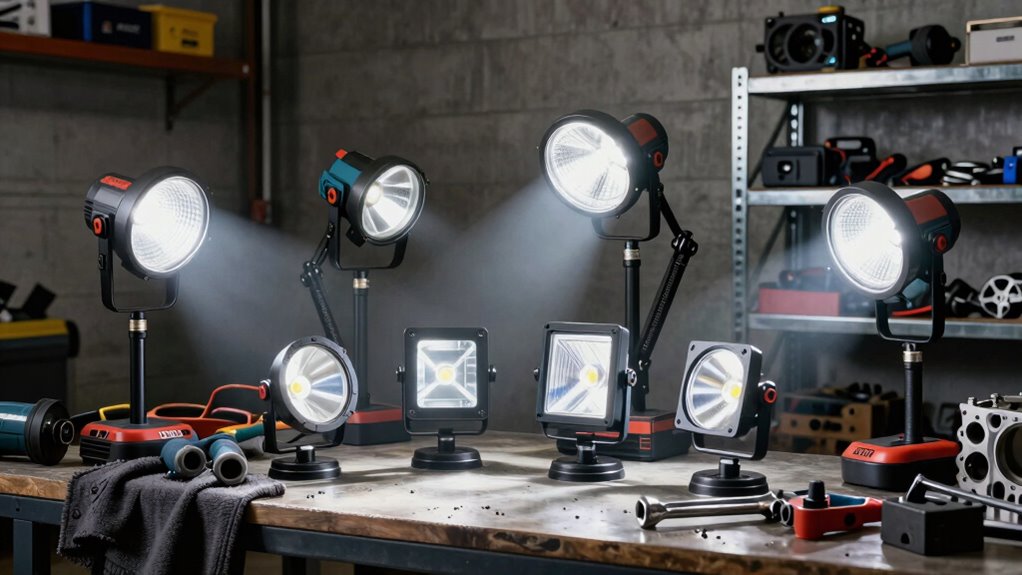
When selecting garage work lights, prioritize features that deliver ideal illumination while guaranteeing safe, efficient operation in demanding environments.
You’ll want lights that withstand dust, moisture, and temperature fluctuations common in garage settings.
- Brightness levels – Look for adjustable lumen outputs ranging from 500-3000 lumens to match specific tasks.
- Durability ratings – Choose fixtures with IP65 or higher protection against dust and water ingress.
- Energy efficiency – LED bulbs consume 75% less energy than traditional incandescent options.
- Heat management – Built-in cooling systems prevent overheating during extended use.
- Flexible positioning – Adjustable arms and swivel mounts let you direct light precisely where needed.
These features guarantee reliable performance when you’re working on projects that demand consistent, bright illumination.
DIY Guide: Evaluating Your Lighting Needs
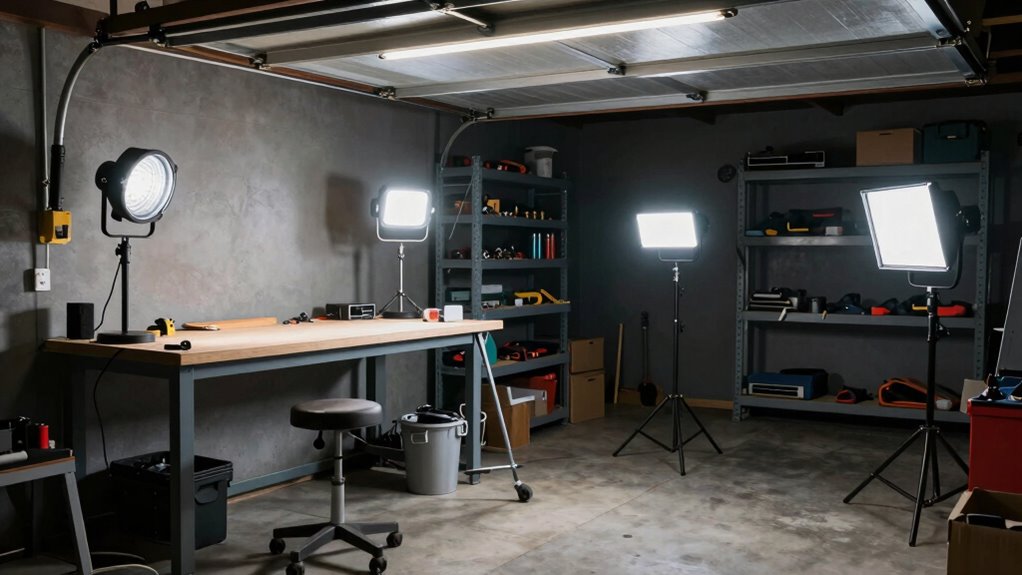
How do you determine the right amount of light for your garage workspace? Start by measuring your garage’s square footage and identifying work zones.
You’ll need at least 100 lumens per square foot for general tasks, but detailed work requires 300-500 lumens. Walk through your space during different times to spot shadows and dark corners.
Consider ceiling height – higher ceilings need more powerful lights. Check existing electrical outlets and wiring capacity before choosing light types.
Don’t forget about heat generation from incandescent bulbs, which can create safety hazards. Evaluate your current lighting gaps by performing actual tasks in various areas.
Mark spots where you frequently work with tools, as these need premium illumination. Your lighting plan should accommodate both overhead and task-specific requirements while maintaining electrical safety standards.
Best Lights for Auto Repair Workspaces
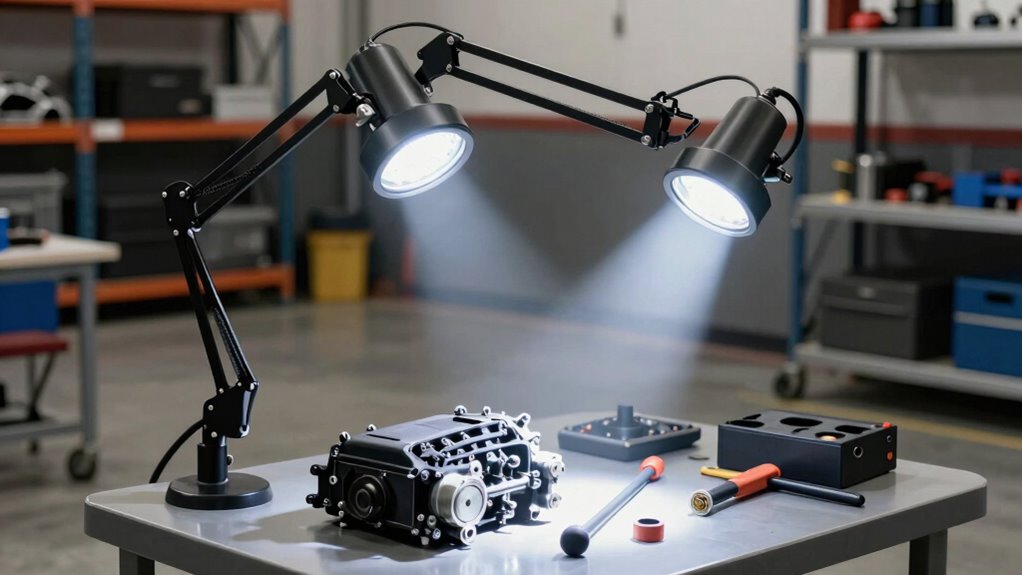
Auto repair work demands precise illumination that goes beyond basic garage lighting requirements.
You need lights that eliminate shadows and provide consistent color temperature for accurate diagnosis.
When selecting lighting for your auto repair workspace, consider these critical factors:
- LED work lights with 5000K-6500K color temperature – This range mimics natural daylight, helping you spot leaks, cracks, and wear patterns accurately.
- Minimum 3000 lumens output – Guarantees adequate brightness for engine compartments and tight spaces.
- Adjustable mounting systems – Position lights exactly where you need them without creating glare.
- IP65 waterproof rating – Protects against oil, coolant, and moisture damage.
- Magnetic or clamp attachments – Provide secure mounting on metal surfaces and workbenches.
Choose lights with impact-resistant housings and safety certifications.
Proper illumination prevents accidents and guarantees quality repairs.
Top Picks for Woodworking & Crafts Areas
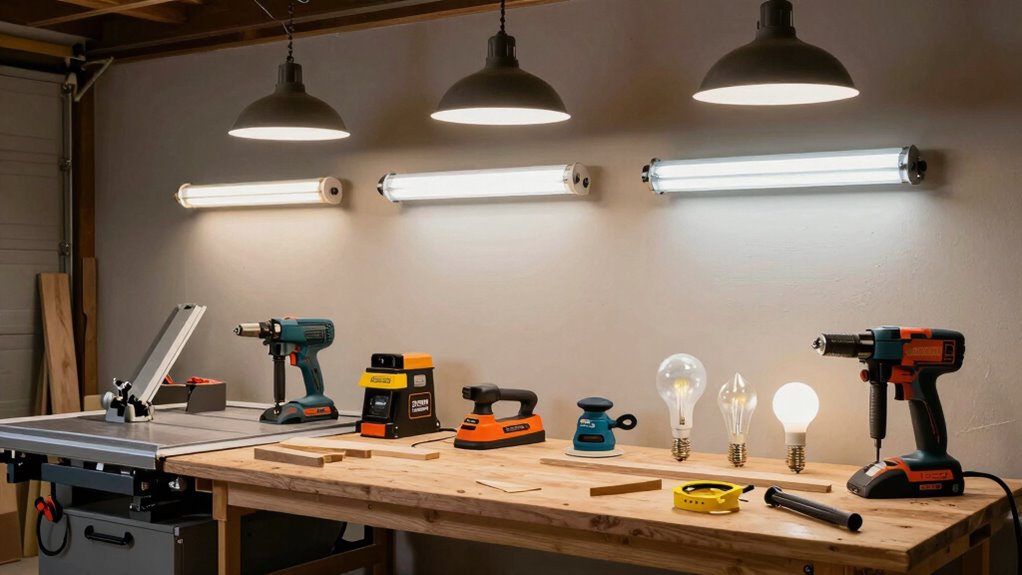
Three key considerations distinguish effective woodworking lighting from general garage illumination.
You need color temperature between 5000K-6500K for accurate wood grain visibility and precise cutting. Brightness requirements reach 800-1000 lumens per fixture to eliminate shadows during detailed joinery work. Adjustable positioning prevents glare while maintaining peak beam direction.
Your fixtures should feature impact-resistant housings and IP65 ratings for dust protection. LED arrays with CRI ratings above 90 guarantee true color representation when matching stains or finishes.
Mount lights at 45-degree angles maximum to reduce eye strain during prolonged projects. Task lighting must illuminate work surfaces without creating hazardous reflections on sharp tools.
You’ll want fixtures with magnetic bases or clamp attachments for flexible positioning. Heat dissipation remains vital – LEDs shouldn’t exceed 140°F during extended woodworking sessions. Battery-powered options provide mobility when you’re moving between workstations.
Affordable Garage Lighting Solutions
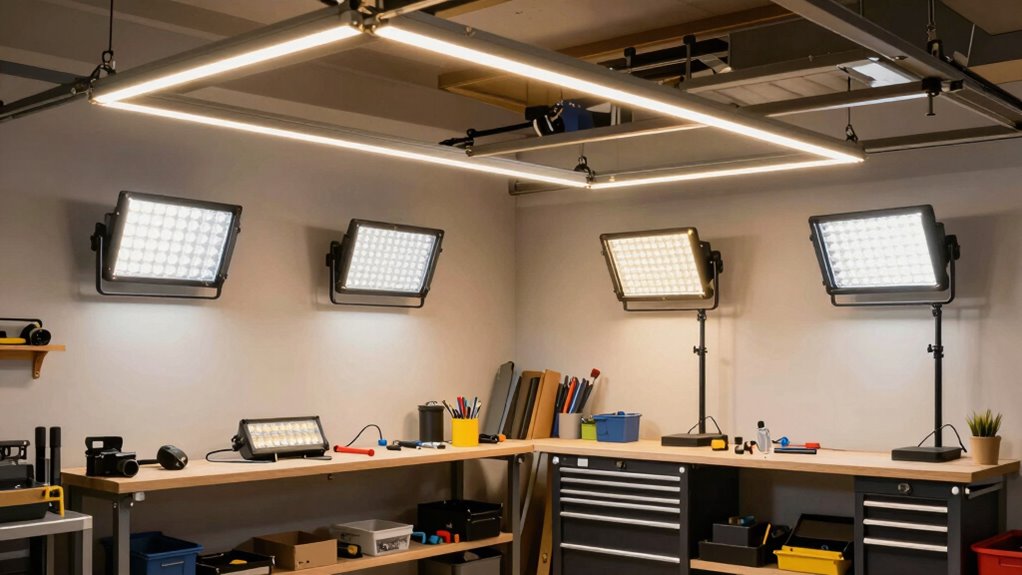
You can equip your garage with cost-effective LED work lights that deliver 800-1600 lumens while consuming minimal power, ensuring adequate illumination for most automotive and storage tasks.
These lights often feature magnetic bases or adjustable mounting brackets that let you position them precisely where needed without permanent installation.
Always verify electrical specifications match your garage’s circuit capacity before connecting any lighting solution.
Budget-Friendly LED Options
LED technology has revolutionized garage lighting by delivering exceptional brightness while consuming minimal energy, making quality illumination accessible without breaking your budget.
You’ll find these options cost-effective and long-lasting.
When selecting budget-friendly LED work lights, consider these essential factors:
- Lumens per watt ratio – Aim for at least 80 lumens per watt for efficient brightness
- Color temperature range – Choose 4000K-5000K for ideal visibility during tasks
- Durability rating – Look for IP65 or higher protection against dust and moisture
- Mounting options – Select models with magnetic bases or adjustable stands
- Safety certifications – verify UL or ETL listing for electrical safety compliance
These specifications assure reliable performance while maintaining affordability.
You’ll appreciate the reduced energy costs and extended lifespan compared to traditional bulbs.
DIY Installation Tips
Installing affordable garage lighting doesn’t require professional assistance when you follow proper procedures and safety protocols.
You’ll need basic tools: drill, wire strippers, screwdriver, and voltage tester. Always turn off power at the circuit breaker before starting any electrical work.
Mount lights securely to ceiling joists or wall studs using appropriate anchors for your garage’s construction material. Connect wires by matching colors: black to black (hot), white to white (neutral), and green or bare copper to ground. Use wire nuts and electrical tape for secure connections.
Test your installation with a multimeter before restoring power. Consider plug-in options if you’re uncomfortable with hardwiring. Follow manufacturer’s mounting instructions precisely.
Make certain fixtures won’t interfere with garage door operation or create glare issues. You’ve got this – proper lighting transforms your workspace completely.
High-End Options Worth Every Penny
While budget-friendly work lights serve basic illumination needs, investing in premium garage lighting systems delivers superior performance and long-term value. You’ll notice the difference immediately.
High-end options provide unmatched brightness, durability, and safety features that cheap alternatives simply can’t match. These systems use advanced LED arrays, premium heat dissipation, and rugged construction.
- LED panel systems offer uniform light distribution without hotspots or shadows
- Magnetic mounting fixtures let you position lights exactly where you need them
- Adjustable beam angle features help you direct light precisely on your workspace
- IP65+ rated housings protect against dust, debris, and moisture
- 50,000+ hour lifespan means you won’t replace bulbs annually
Premium work lights eliminate eye strain, reduce accidents, and make garage projects safer.
You belong among serious DIYers who demand reliable, professional-grade equipment.
Proper Installation & Light Positioning
Mounting height and angle determine how effectively your garage lighting system performs. Position fixtures between 7-8 feet above the floor to minimize shadows and guarantee adequate coverage.
Angle lights downward at 30-45 degrees to illuminate work surfaces directly. Install multiple fixtures evenly spaced across the ceiling to eliminate dark spots. Ascertain electrical connections are secure and properly grounded before powering on.
Use appropriate mounting hardware for your ceiling type – toggle bolts for drywall, lag bolts for wooden beams. Position switches at convenient entrance points. Consider motion sensors for automatic activation.
Verify all connections meet local electrical codes. Test light distribution after installation, adjusting fixture angles as needed. Proper positioning prevents eye strain during detailed work.
Common Garage Lighting Mistakes
Incorrect fixture selection can compromise both safety and productivity in your garage workspace. Many homeowners make the mistake of choosing lights with insufficient lumens, leading to poorly lit areas that increase accident risk during projects.
You’ll want to avoid these common mistakes:
- Installing lights without considering your workspace layout and shadow zones
- Choosing fixtures with inadequate lumen output for your garage’s square footage
- Ignoring color temperature needs for detailed work visibility
- Overlooking fixture durability and impact resistance for workshop conditions
- Failing to plan for adequate light distribution across your entire workspace
These errors create hazardous conditions where you’re working in shadows, straining your eyes, and potentially missing critical details during repairs or projects.
Outdoor Lights Safe for Indoor Use?
Garage lighting decisions become more complex when you consider whether outdoor-rated fixtures can safely and effectively operate indoors. You shouldn’t automatically assume outdoor lights work indoors because they’re built for different environmental conditions.
Outdoor fixtures often have higher IP ratings, meaning they’re sealed against moisture and debris that aren’t concerns inside your garage. However, many outdoor LED work lights safely function indoors since they handle voltage fluctuations and temperature extremes.
Check manufacturer specifications for indoor suitability before purchasing. Look for UL listings that approve indoor use.
Avoid using outdoor lights with high moisture protection ratings unnecessarily, as they might overheat in enclosed indoor spaces. You’ll want fixtures designed for your garage’s specific conditions, not just maximum durability ratings.
Test Light Coverage Before Buying
How do you guarantee your chosen work light actually illuminates your workspace effectively? Don’t rely on manufacturer claims alone. Test coverage before purchasing to verify adequate illumination where you work.
- Map your workspace dimensions to determine required lumens and beam spread.
- Check for shadow zones behind workbenches, vehicles, or storage units.
- Test light positioning at various angles to eliminate dark spots.
- Verify color temperature suits your tasks (5000K-6500K for garages).
- Confirm mounting compatibility with your ceiling height and structure.
Position potential lights in your actual workspace. Walk around your garage with tools in hand, checking illumination levels. Your light should eliminate shadows where you’ll be working.
Take measurements seriously – inadequate lighting causes eye strain and safety hazards. Make sure you’re getting the right coverage for your specific garage layout and work requirements.
Extend the Life of Your Garage Lights
Once you’ve confirmed your work light provides adequate coverage for your garage workspace, protecting that investment requires understanding how environmental factors and usage patterns affect longevity.
You should regularly clean dust and debris from fixtures, as accumulation reduces light output and causes overheating.
Maintain proper ventilation around lights to prevent excessive heat buildup that shortens bulb life.
You’ll want to avoid frequent on/off cycling that stresses electrical components.
Install lights away from direct water spray and chemical exposure.
Use appropriate dimming controls when available to reduce wattage consumption.
You should replace bulbs promptly when they fail to prevent damage to sockets and wiring.
Consider LED options that handle temperature fluctuations better than traditional incandescent bulbs.
Regular inspection catches loose connections and damaged wiring before they create safety hazards.
Conclusion
Don’t let poor lighting dim your productivity—a study found that proper LED garage lighting reduces eye strain by 60%. Like a mechanic who spent $200 on a high-lumen LED fixture and reclaimed hours of clear, focused work time, you deserve illumination that matches your tasks. Choose lights rated for your space’s challenges.
