

You’re standing in your orchard, secateurs in hand, staring at a tangled maze of branches that once promised abundant harvests. Winter’s bare limbs reveal the true structure of your fruit trees, exposing crossing shoots and crowded centers that choke productivity. Before you make the first cut, understanding proper pruning technique isn’t just helpful—it’s essential. Poor pruning wounds trees permanently, while strategic removal of specific branches transforms struggling plants into robust producers. Mastering this balance separates thriving orchards from disappointing ones.
Boost Fruit Harvests With Strategic Pruning
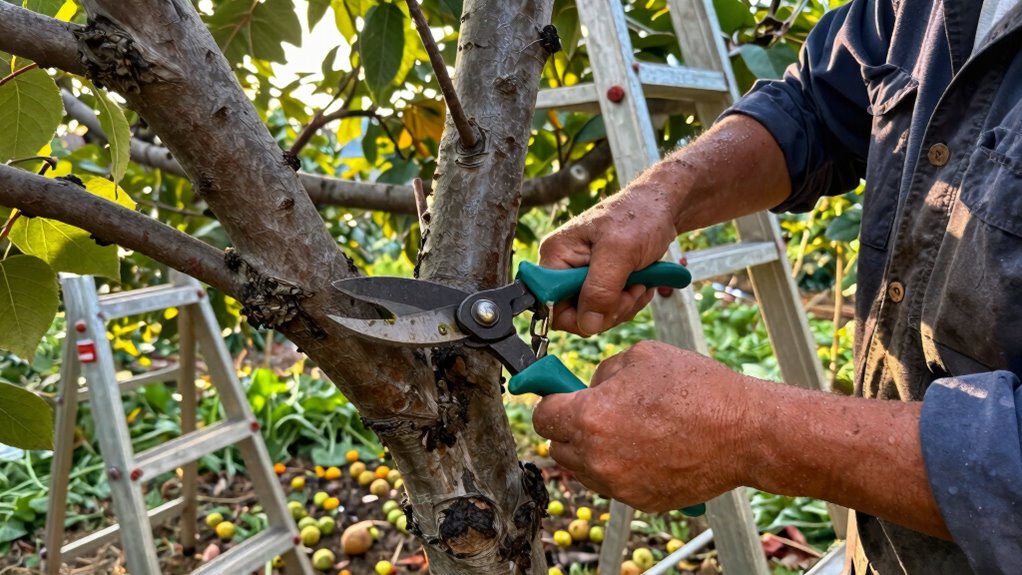
When you prune fruit trees strategically, you directly influence their productivity by redirecting energy toward fruit-bearing branches. Remove dead, diseased, or crossing limbs first.
Cut back vertical shoots that compete with main scaffold branches. Thin interior branches to improve air circulation and light penetration.
Make clean cuts just outside the branch collar. Focus on maintaining an open center or modified central leader structure.
Remove water sprouts and suckers completely. Trim lateral branches that grow inward toward the tree’s center.
Keep fruiting spurs intact during dormant pruning. Cut away old, unproductive wood annually.
Balance vegetative growth with fruit production by selectively removing excessive branch mass. Proper technique guarantees maximum yield while maintaining tree health and structural integrity through systematic removal of non-essential growth.
Choose the Right Time to Prune
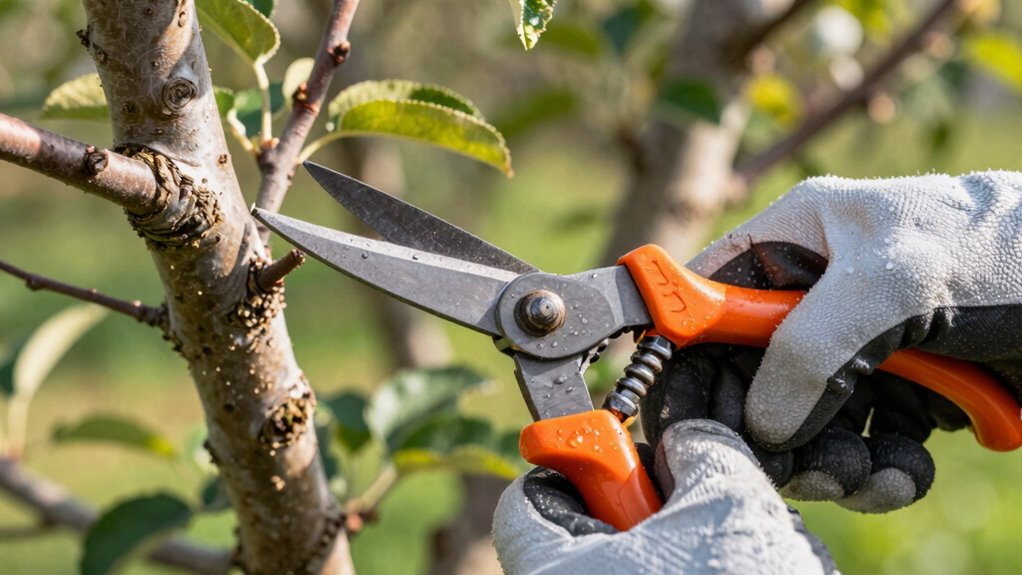
Pruning fruit trees at the correct time maximizes your efforts and minimizes stress on the tree. You should prune during dormancy, typically late winter or early spring before bud break. This timing allows you to see the tree’s structure clearly while avoiding sap loss.
Avoid pruning during fall since cuts won’t heal properly before winter damage occurs. Summer pruning works for specific purposes like removing water sprouts or controlling size, but limit it to light trimming.
Stone fruits like peaches need pruning after harvest, while apples and pears respond well to winter pruning. Your local climate zone determines exact timing, so observe your tree’s dormancy patterns.
Make clean cuts quickly to prevent disease entry. Timing directly affects healing, growth response, and fruit production quality.
Gather Essential Pruning Tools
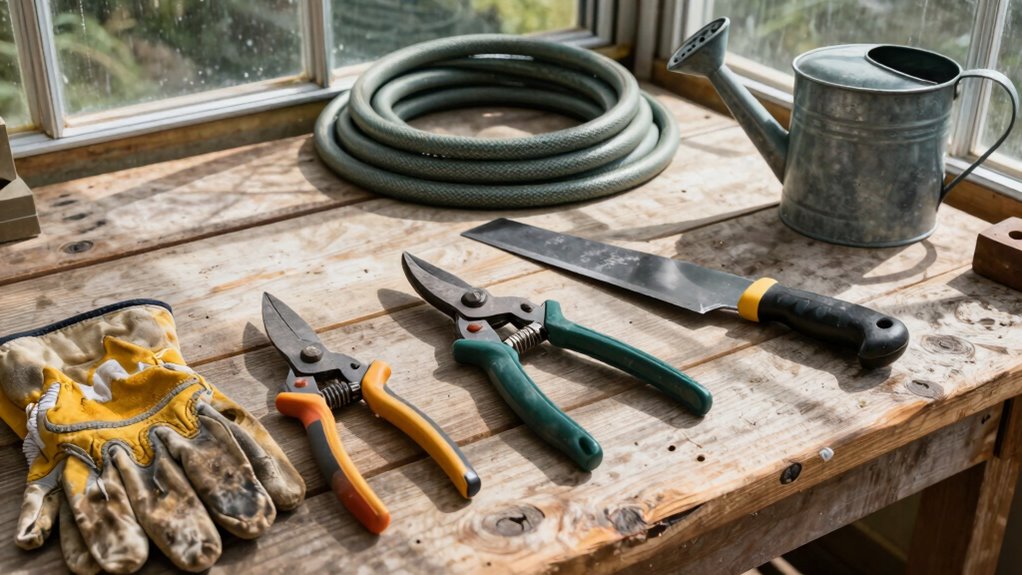
Having sharp, clean tools guarantees precise cuts that heal quickly and minimize disease risk.
You’ll need bypass pruners for branches up to three-quarters inch diameter, making clean slicing cuts without crushing tissue.
Grab loppers for thicker growth up to two inches, providing leverage through their longer handles.
A pruning saw handles anything larger, with curved blades designed specifically for tree work.
Always disinfect blades between cuts using rubbing alcohol or bleach solution to prevent pathogen spread.
Keep tools sharpened regularly with whetstones or professional services.
Store everything in a dry place after cleaning.
Wearing gloves protects your hands while giving you necessary grip control during extended pruning sessions.
These essential tools form your reliable pruning kit.
Identify Branches That Should Go
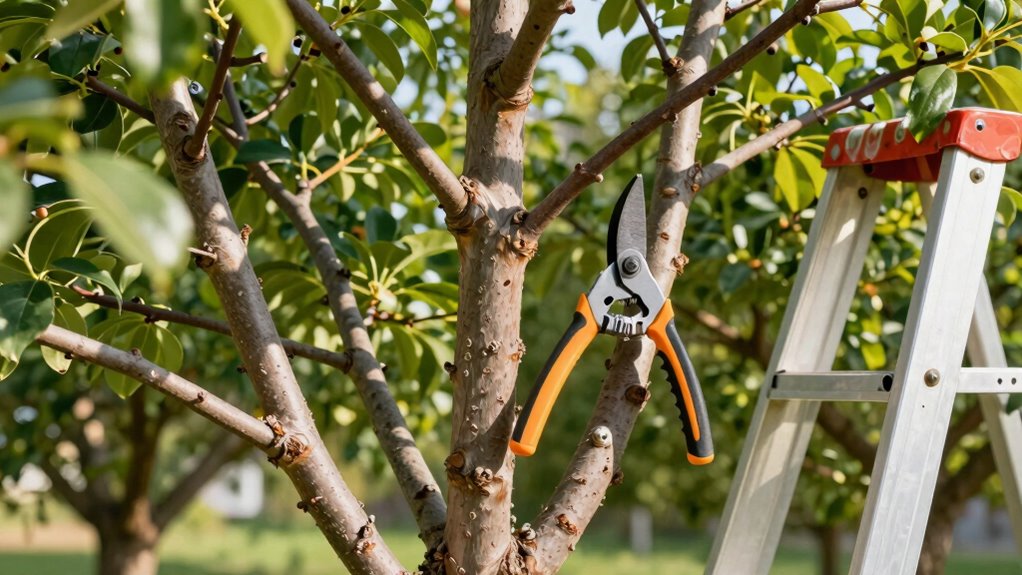
You must first identify dead or diseased limbs that show no signs of life, such as brittle bark or discolored wood, and remove them immediately to prevent pathogen spread.
Next, you should locate crossing branches that rub against each other, creating wounds that invite disease and reduce air circulation within the canopy. These problematic branches require systematic removal to maintain tree health and optimize fruit production.
Dead Or Diseased Limbs
When branches show signs of death or disease, they require immediate removal to prevent spreading pathogens throughout the tree.
You’ll recognize dead limbs by their brittle bark, lack of buds, and hollow sound when tapped. Diseased branches often display discolored leaves, cankers, or fungal growth.
Examine each branch systematically, checking for these warning signs. Don’t hesitate to remove affected wood – you’re protecting the entire tree’s health.
Make clean cuts at branch collars, avoiding stubs that invite further infection.
Sterilize your tools between cuts using rubbing alcohol or bleach solution. You’ll prevent cross-contamination this way.
Remember that removing diseased material protects your investment and guarantees future harvests. Your tree depends on your decisive action.
Crossing Branch Removal
While examining your fruit tree’s canopy, identify branches that cross or rub against each other, as these intersections create wounds that invite disease and pest infiltration.
Look for branches growing toward each other from opposite directions, those that overlap horizontally, and any limbs that physically touch during wind movement. These contact points abrade bark, weakening the tree’s natural defenses.
Prioritize removing smaller diameter branches first, keeping those with better structural placement. When two branches compete equally, remove the one growing downward or toward the tree’s center.
Cut back to the branch collar, avoiding stubs that won’t heal properly. Focus on maintaining an open canopy that allows air circulation and sunlight penetration throughout the tree’s interior.
Prune Young Trees for Strong Growth
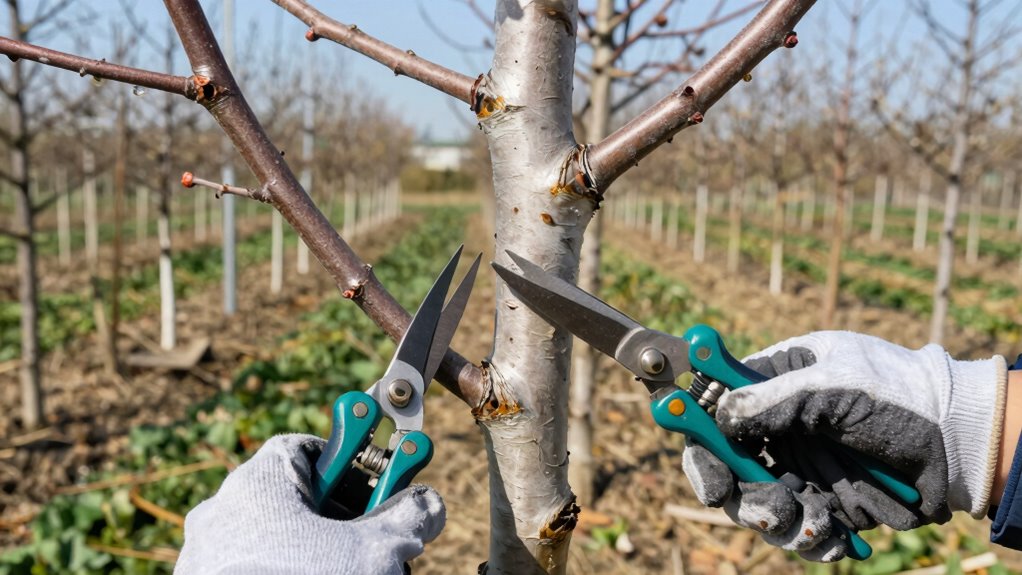
Because young fruit trees require careful structural development, pruning during their first few years establishes the foundation for lifelong productivity and tree health.
You should focus on creating a strong central leader while maintaining balanced branch distribution. Remove competing leaders immediately, as they weaken the tree’s structure.
Select three to five well-spaced lateral branches that form wide crotch angles, ideally between forty-five and ninety degrees from the trunk. These scaffold branches shouldn’t crowd each other.
Eliminate any branches with narrow crotches, as they’re prone to splitting under fruit weight. You must also remove water sprouts, suckers, and any growth below the graft union.
Make clean cuts just outside the branch collar to promote proper healing.
Consistent annual pruning encourages vigorous growth while establishing your tree’s permanent shape and strength.
Revive Old or Neglected Trees
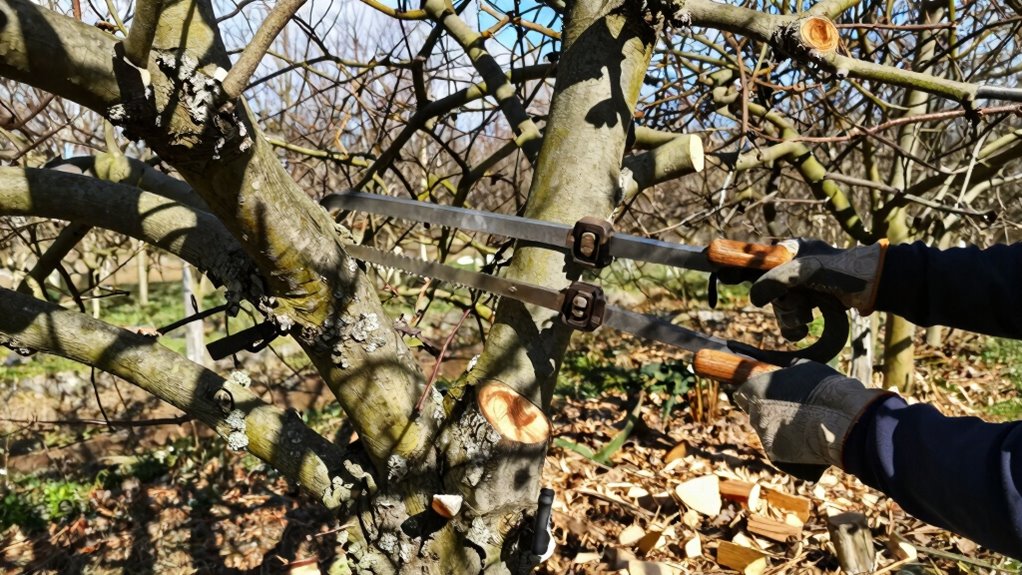
Although older fruit trees that have been neglected often appear beyond recovery, you can restore their productivity through systematic renewal pruning.
Start by removing dead, diseased, and broken branches completely. Cut back crossing limbs that rub against each other. Thin out crowded areas to improve air circulation. Remove water sprouts and suckers growing from the base.
Gradually reduce the tree’s height over three years, cutting no more than one-third annually. Make clean cuts just outside the branch collar.
Focus on opening the canopy center to allow light penetration. Remove branches growing toward the trunk or at sharp angles. Eliminate competing leaders.
You’ll see new fruiting wood develop within two seasons when you follow this methodical approach consistently each year.
Prune Apple and Pear Trees Right
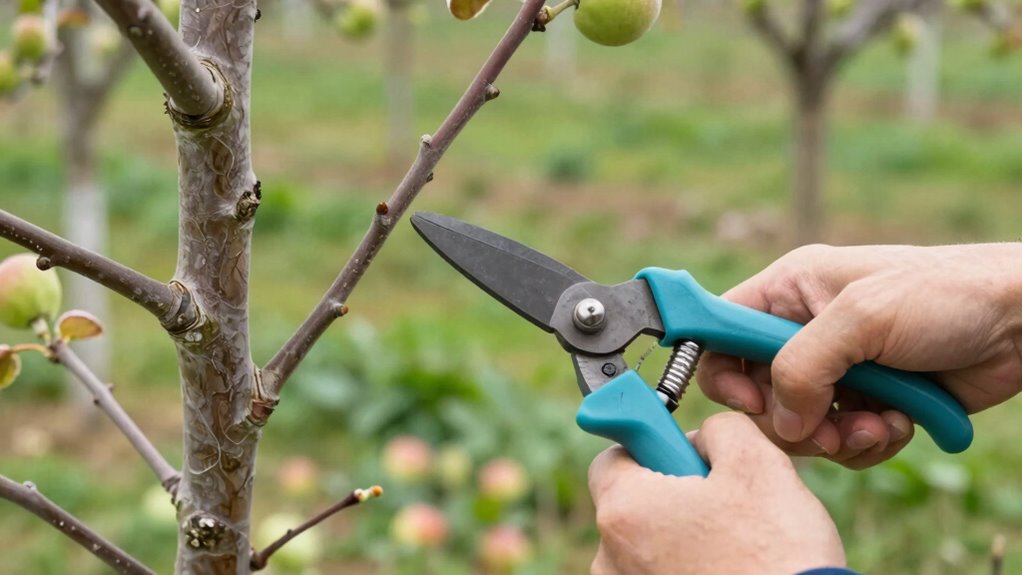
You should prune apple and pear trees during late winter or early spring before new growth begins, as this timing minimizes stress and promotes ideal healing.
Make clean cuts at a 45-degree angle just above an outward-facing bud, ensuring your tools are sharp and sterilized to prevent disease transmission.
These precise cutting techniques and timing decisions directly impact your trees’ fruit production and overall structural integrity.
Optimal Timing For Pruning
When pruning apple and pear trees, timing matters more than the specific techniques you employ. You should prune during dormancy when trees aren’t actively growing.
- Late winter timing: Prune just before spring bud break, typically February through March in most regions. This minimizes stress while maximizing healing response.
- Avoid fall pruning: Don’t prune after mid-summer because it stimulates new growth that won’t harden properly before winter frost damage.
- Weather considerations: Choose days when temperatures stay above freezing for several days afterward. This prevents pruning cuts from experiencing freeze-thaw cycles that cause bark damage.
Proper timing guarantees your trees respond positively to pruning cuts while maintaining peak health and productivity throughout their growing cycle.
Proper Cutting Techniques
Master proper cutting techniques to secure clean wounds that heal quickly and minimize disease entry points.
You’ll make three essential cuts: remove dead, diseased, or damaged wood first, then eliminate crossing branches that rub together.
Make heading cuts just above outward-facing buds at a forty-five-degree angle.
For larger limbs, use the three-cut method: undercut fifteen inches from the trunk, top-cut slightly farther out to remove the bulk, then final cut close to the branch collar without damaging it.
Sharp bypass pruners work best for small branches under three-quarters inch diameter.
You should sterilize tools between cuts when removing diseased wood.
Cut cleanly without leaving stubs or tearing bark. Proper technique secures rapid healing and strong new growth.
Special Tips for Stone Fruit Trees
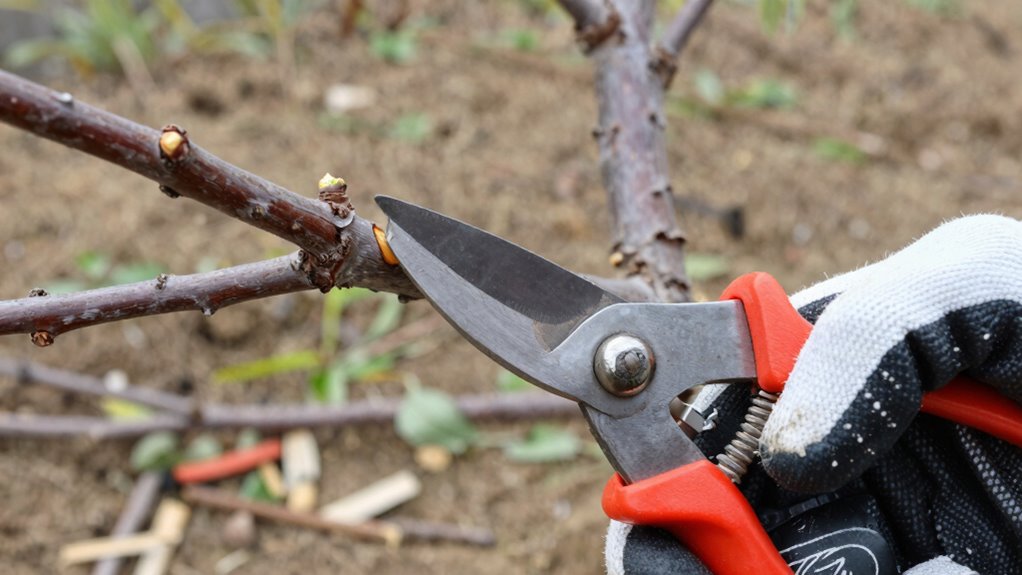
While pruning stone fruit trees follows the same fundamental principles as other fruit trees, these species require specialized attention to their unique growth habits and disease susceptibilities.
You must understand their specific needs to maximize yield and tree health.
- Dormant season timing: Prune during late winter when trees are dormant but before bud break. This minimizes disease entry points and reduces stress on the tree’s vascular system.
- Branch angle management: Maintain 45-60 degree branch angles to prevent weak crotches that split under fruit weight. Remove narrow-angled branches that create structural weaknesses.
- Disease prevention cuts: Make clean, angled cuts above outward-facing buds. Remove diseased, dead, or crossing branches immediately to prevent pathogen spread through the canopy.
Adjust for Citrus Tree Growth
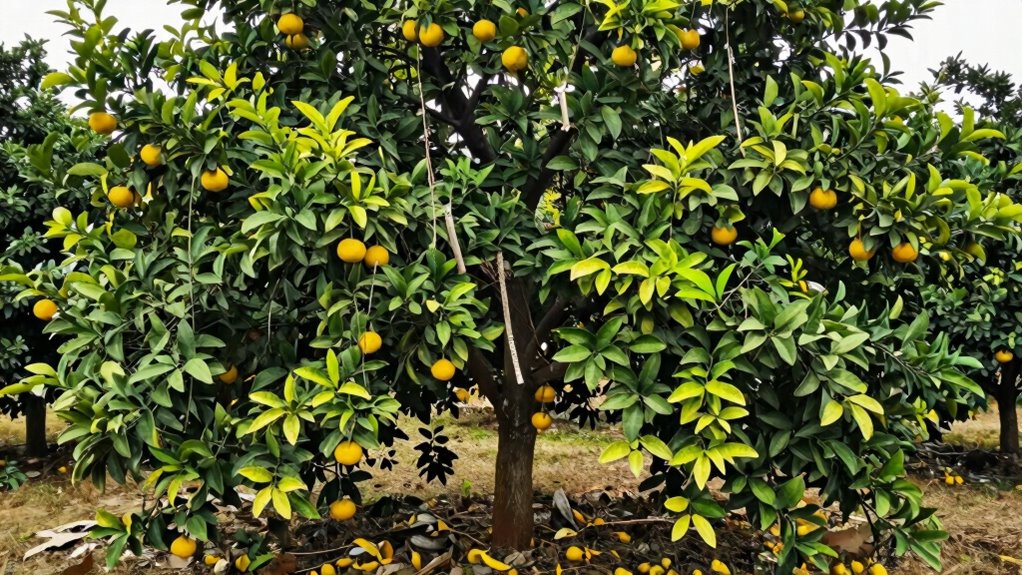
You must adjust your pruning approach when working with citrus trees since their growth patterns differ greatly from stone fruits.
Your cuts should account for citrus trees’ tendency to produce water sprouts and their year-round growing cycle rather than seasonal dormancy.
You’ll need to modify your technique to accommodate these evergreen characteristics while maintaining proper tree structure and fruit production.
Citrus Tree Pruning Techniques
Citrus trees require different pruning approaches than deciduous fruit trees due to their evergreen nature and continuous growth patterns.
You’ll need to understand their unique branching structure and flowering habits to prune effectively.
- Timing: Prune citrus trees during late winter or early spring when growth slows, avoiding summer pruning that can stimulate excessive vegetative growth instead of fruit production.
- Structural pruning: Remove dead, diseased, or crossing branches first, then thin interior branches to improve air circulation and light penetration throughout the canopy.
- Heading cuts: Make selective cuts just above outward-facing buds or lateral branches to encourage outward growth and prevent overcrowding while maintaining productive wood distribution.
Focus on maintaining the tree’s natural shape while promoting healthy growth.
Growth Pattern Adjustments
Although citrus trees exhibit continuous growth throughout the year, their branching patterns require strategic adjustments to maintain peak productivity and structural integrity. You must identify vertical shoots and water sprouts that compete with fruit-bearing branches. Remove these vigorously growing stems entirely at their base.
Selectively thin crowded areas to improve air circulation and light penetration. You should train young trees by selecting three to four well-spaced scaffold branches positioned eighteen inches apart vertically. Maintain this framework through annual adjustments.
Redirect growth by cutting back overly vigorous branches to outward-facing buds. This encourages lateral branching and prevents excessive height. You must also remove crossing or rubbing branches completely.
Make clean cuts just outside branch collars using sharp tools. These systematic adjustments keep your citrus tree productive while establishing proper structure for long-term health and prime fruit production within confined spaces you manage.
Seasonal Pruning Schedule
While citrus trees don’t experience dormancy like deciduous fruit trees, their continuous growth pattern requires strategic timing for pruning interventions.
You must understand that citrus trees produce flowers and fruit throughout the year, making timing essential for ideal yields.
- Late winter to early spring – Prune after harvest but before bloom initiation to minimize fruit loss and encourage new growth for upcoming seasons.
- Post-harvest maintenance – Remove dead, diseased, or crossing branches immediately after picking fruit to prevent energy waste and maintain tree structure.
- Summer cleanup pruning – Lightly trim during growing season to remove water sprouts and maintain shape without sacrificing current fruit production.
Timing directly impacts your tree’s productivity and lifespan.
Avoid These Common Mistakes
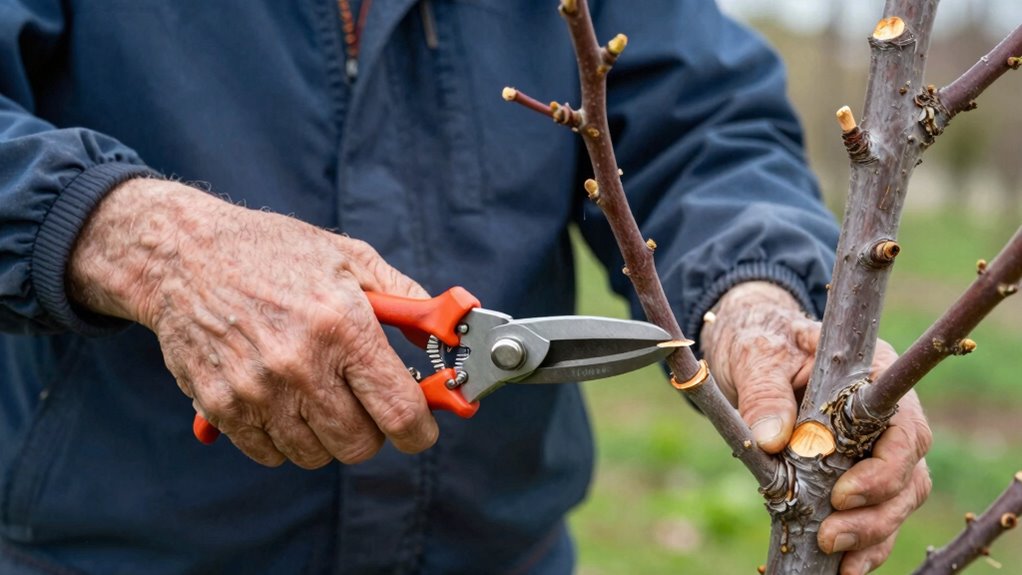
When you prune fruit trees, making cuts at the wrong time or angle can severely damage your tree’s health and productivity. You shouldn’t prune during extreme weather conditions or when disease pressure is high. Cutting too much foliage reduces photosynthesis, weakening the tree’s energy reserves.
Avoid topping branches, which creates weak regrowth and invites disease. Don’t make flush cuts against the trunk, as this damages the branch collar essential for healing. You must resist pruning suckers and water sprouts unless they’re competing with productive branches.
Over-pruning stimulates excessive vegetative growth instead of fruit production. Always consider your tree’s natural shape and growth pattern. You’re working with living tissue that responds to stress, so each cut affects the tree’s hormonal balance and energy distribution throughout the canopy.
Make Clean, Safe Tree Cuts
You must select the appropriate cutting tools for each branch diameter and wood type you encounter.
Position your cuts at precise angles that promote rapid healing while preventing water accumulation and disease entry.
Treat all wounds immediately with proper sealants to protect the tree’s vascular system from pathogens.
Proper Tool Selection
Selecting the proper tools for pruning fruit trees is essential for making clean, safe cuts that promote tree health and longevity. You must choose tools that match your tree’s branch diameter and your skill level to achieve professional results.
- Hand pruners work best for branches under ¾ inch diameter, providing precise control for detailed pruning tasks.
- Loppers handle branches between ¾ and 1½ inches, offering leverage and clean cutting action through tougher wood.
- Pruning saws tackle larger branches over 1½ inches, featuring specialized teeth patterns designed for efficient cutting without bark damage.
Each tool requires sharp blades and proper maintenance. You should disinfect tools between cuts to prevent disease transmission.
Invest in quality tools that feel comfortable in your hands.
Safe Cutting Angles
While proper tool selection guarantees you can make effective cuts, understanding safe cutting angles prevents damage to your fruit trees and promotes healthy healing.
You should always cut at a 45-degree angle away from the tree’s center, following the branch’s natural collar slope. This angle allows water to run off properly, preventing moisture buildup that causes rot.
Make your cuts just outside the branch bark ridge and branch collar intersection. Avoid cutting flush against the trunk or leaving stubs longer than one-quarter inch.
Position your saw or pruner so the blade faces away from the tree’s interior. Cutting downward through branches prevents tear-out on the bark side.
Remember that improper angles create wounds that heal slowly and invite disease pathogens into your tree’s vascular system.
Clean Wound Treatment
A clean cut heals faster and reduces disease entry points into your fruit tree’s vascular system. You must sanitize pruning tools between cuts using rubbing alcohol or bleach solution to prevent pathogen transmission. Proper wound treatment requires immediate attention to prevent infection and promote rapid healing.
- Cut Removal Technique: Remove damaged tissue by cutting back to healthy wood, making clean cuts just outside the branch collar without leaving stubs that invite decay organisms.
- Wound Dressing Application: Apply commercial wound dressing or sealing compound to large cuts exceeding one inch diameter, ensuring complete coverage of exposed cambium layer to minimize moisture loss and pathogen entry.
- Healing Promotion Methods: Position cuts at proper angles to facilitate water runoff, avoid cutting into healthy bark, and maintain tree’s natural defense mechanisms by respecting branch protection zones during pruning operations.
Dispose of or Repurpose Branches
After you’ve completed the pruning process, you’ll need to decide what to do with the removed branches.
Sort them by size and condition immediately. Diseased or pest-infested material requires disposal through burning or municipal collection to prevent pathogen spread.
Healthy branches smaller than one inch diameter make excellent mulch when chipped properly. Larger limbs serve as firewood after splitting and seasoning for twelve months.
Consider repurposing sturdy branches as garden stakes or trellising material for supporting new growth. Green wood chips mixed into compost piles accelerate decomposition while adding carbon content.
Store valuable cuttings in cool, dry conditions if planning propagation through grafting or rooting.
Document removed branch quantities and destinations for future reference. Proper disposal prevents disease cycles and maintains orchard health standards expected by serious growers.
Know When to Look Beyond Pruning
Pruning alone can’t address all issues affecting fruit tree health and productivity. You must recognize when additional interventions become necessary for ideal tree performance.
- Nutritional deficiencies require soil testing and targeted fertilization programs when leaves show chlorosis or stunted growth despite proper pruning cuts.
- Disease management demands integrated approaches including sanitation practices, fungicide applications, and resistant variety selection when pathogens persist after pruning interventions.
- Environmental stress mitigation involves irrigation system optimization, mulching strategies, and windbreak establishment when trees exhibit drought stress or physical damage beyond pruning correction.
These systematic approaches complement pruning techniques, creating thorough tree care protocols that maximize your investment in proper orchard management practices.
When Should You Call a Professional Tree Pruner?
While you can handle many pruning tasks yourself, certain situations demand professional expertise to guarantee tree health and safety.
You should call a professional when trees exceed twenty feet in height, requiring specialized equipment and climbing skills. Large limb removal near power lines or structures needs certified arborists who understand electrical hazards and property protection.
Diseased trees showing fungal infections, bacterial cankers, or viral symptoms require diagnostic expertise you might lack. Advanced pruning techniques like restoration pruning for neglected trees, or structural pruning for young specimens, require professional knowledge.
You’ll also need professionals for tree removal, stump grinding, or when dealing with protected species requiring permits. Insurance coverage becomes essential for large-scale work.
Don’t risk personal safety or tree health when proper technique, specialized tools, and experience determine success. Professional arborists carry liability insurance and possess current certifications. Their systematic approach guarantees the best tree recovery and long-term productivity while protecting your investment.
Conclusion
Pruning fruit trees correctly transforms your orchard like a skilled surgeon revitalizes a patient. You’ve learned to time cuts precisely, select proper tools, and identify problematic branches. Don’t forget clean cuts prevent disease entry. Young trees need structural training while mature ones require maintenance pruning. Remove debris properly and recognize when professional intervention becomes necessary. Consistent, methodical pruning guarantees peak tree health and maximum fruit production year after year.
